


Private higher education investment the key to 'activating knowledge', says report
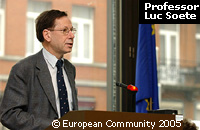
According to a new report prepared for the UK Presidency and discussed at the informal European Council at Hampton Court on 27 October, knowledge in Europe has remained unused and under exploited - in other words, passive - and what is needed is a policy of 'activating knowledge'. The report, prepared by Luc Soete, director of the Institute for New Technologies at the United Nations University, stresses that in financial terms, European public investment in knowledge is broadly comparable to that of the US. 'But they are scattered over a multitude of public research and higher education institutions across the EU,' it adds. However, it is the difference in private investments in knowledge between the EU and US that is most striking, according to Professor Soete: 'In the EU as a whole we fail to convince our firms and our citizens to invest in knowledge. It is a failure which is first and foremost a failure to 'activate', to open up higher education to private funding.' Europe must address higher education reform as an absolute priority if it is to compete in the knowledge economy, says the report, and whilst education is primarily a Member State competence, the EU has a complementary role to play in bringing a European dimension to education policies. The situation is just as challenging when it comes to research, according to the analysis. Again Professor Soete draws a comparison with the US, where 95 per cent of university research funding from federal sources is spent in just 200 institutions (out of a total of 3,300). 'This has brought about a concentration and scale of research which is incomparable with what we have in Europe today.' What is needed, therefore, is a policy of activating knowledge, which should aim to activate competencies, risk taking and innovation, and the report makes a number of proposals for achieving this. Firstly, EU countries must identify a more efficient means of cooperating than the 'rather soft' Open Method of Coordination, which Professor Soete's paper says 'hasn't been very successful'. Next, the report proposes introducing a single overall 'knowledge investment' target for Member States, combining all the various components of knowledge investment, including spending on education and both private and public funds. 'The broadening of the knowledge concept to [include] education would [...] enable Member States to address particular weaknesses in their education systems as an integral part of their knowledge and innovation investment strategy,' claims the report. In addition, Europe should make a concerted effort to open up research and higher education to private funding, and the report calls for an evaluation of the merits of introducing an EU wide framework for R&D tax credits. As previously mentioned, university reform should also be a priority, with a focus on creating the necessary critical mass in European institutions. 'One way to do this would be to strengthen universities specializing in specific areas and with sufficient by-in from industry,' argues the report. 'We then need to foster competition between those universities. [...] This competitive aspect has been one of the key reasons for the dynamism of the US higher education system.' Finally, the author warns that a unilateral focus on strengthening knowledge and innovation only within Europe reflects an out-dated 'Eurocentric' approach. 'Our policies can be rooted in one geographic jurisdiction but their scope and perspective must be global. European welfare will in the long term be directly influenced [...] by the development of joint global standards and the rapid world-wide diffusion of technologies to other, non-EU countries. Think of energy saving, environmental sustainability, but also health and security.' Professor Soete concludes by saying: 'I have outlined here what the major challenges are before us in 'activating knowledge'. [...] Stakeholders in society (trade unions, firms, governments, educational institutions and most importantly individuals) all have a role to play in making this change a reality. Let's challenge them.'
Countries
United Kingdom