


First pan-European student satellite successfully launched
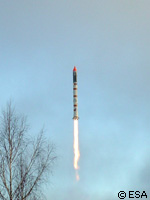
SSETI Express, a low Earth orbit spacecraft designed and built by European university students under the supervision of ESA's Education Department, was successfully launched on 27 October from the Plesetsk Cosmodrome in Russia. Under the slogan 'Let's launch the dream!' 23 university groups from 13 European countries and Canada worked together via the Internet to jointly develop and build the SSETI (student space exploration and technology initiative) satellite currently orbiting the Earth. Neil Melville, SSETI project manager, expressed his joy from Plesetsk: 'SSETI Express is a big success and we congratulate all the students involved for their outstanding effort.' The small 62 kg craft, similar in size and shape to a washing machine, set off at 08:52 CEST on board a Russian Kosmos 3M launch vehicle. An hour and forty minutes later, the ground control centre at the University of Aalborg in Denmark received the first signals from the satellite. Ground stations all over the world confirmed acquisition of SSETI Express and first reports are that the spacecraft is in good health. The project team are examining the initial data and assessing the stability of the mission. On board SSETI were three pico-satellites, extremely small satellites of around 1 kg each, which were deployed once SSETI Express was in orbit, marking a first not only for the students but also for the space sector. In addition to acting as a test bed for many designs, including a cold-gas attitude control system, SSETI Express will also take pictures of the Earth and function as a radio transponder. SSETI was launched by ESA's Education Department in 2000 to get European students involved in real space missions through the distributed design, development, implementation and launch of microsatellites. By giving them this chance, the initiative aims to encourage these students to take up careers in space technology and science, thereby helping to create a pool of talented experts for the future. The SSETI Programme, with ESA's assistance, set up a network of individuals and academic institutions, and by harnessing their joint expertise and distributing the work among them, SSETI Express was developed and built in less than one year. The underlying idea of the SSETI Express mission was that while many universities are capable of building hardware, testing and integrating a whole spacecraft is beyond most of their means. More than 400 European students have made an active, long-term contribution to the initiative, either as part of their degree course or in their spare time, and many hundreds more have been indirectly involved in or inspired by SSETI. Prior to launch, radio amateurs worldwide were asked to help collect data from SSETI Express. To encourage them, ESA's Education department supplied free downloadable software to demonstrate that the amateur radio ground station 'network' is a valuable resource for satellite projects. SSETI students are currently working on two other main projects: SSETI ESEO (European student earth orbiter) - a 120 kg spacecraft designed for Ariane 5 and scheduled for launch in 2008, and SSETI ESMO (European student Moon orbiter) - scheduled for launch in 2010-12, which will conduct experiments both on its way to the Moon and once lunar orbit is achieved.