


Science communication 'is more than a priority, it's an obligation' says Potocnik
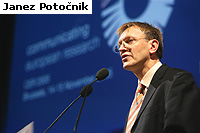
Science and Research Commissioner Janez Potocnik promised a 'fundamental change in the way we communicate science at European level' during his opening speech to the second annual Communicating European Research conference in Brussels on 14 November. Some 3,000 scientists, journalists and policy makers were gathered for the event, which aims to explore how science can, and why it must, reach out to a wider audience. 'Research has the potential to address and answer society's pressing needs and concerns,' Mr Potocnik told the audience. 'Therefore, communicating research and engaging with the public is more than a priority. It's an obligation [...] because research has a daily impact on all European citizens as a result of the choices we make and the policies we design.' However, with 40 per cent of the European population claiming that they hardly ever read articles on scientific subjects because they either do not care or do not understand them, the Commissioner knows that he faces a tough task. 'We need to confront the increasing indifference of young people to science [...] and the growing gap between those who have access to knowledge and those who do not,' he said. Part of the answer, said Mr Potocnik, lies in listening to European citizens and addressing their concerns. 'We need to help scientists in making science more attractive; we need to explain science in clear and understandable terms, and, we need to demonstrate the results of science, its use and impact on daily life.' To achieve this, two key ingredients are required: a greater public recognition of the role of researchers in society, and a willingness among researchers to acquire the communication skills necessary to inform society of their discoveries. Mr Potocnik cited initiatives such as the recent 'European Researcher's Night' as ways of achieving both. While researchers and citizens are respectively the source and the target audience for science communications, the media plays a crucial intermediary role. However, according to the Commissioner reporting on research is a difficult task for journalists. 'Not only do they have to familiarise themselves with the scientific content and verify it, they also need to translate it for the public,' he said. Scientists, meanwhile, are often reluctant to deal with the media due to a tendency to over-simplify the issues. For its part, the Commission intends to approach issues of communication in a more strategic manner across all areas of research, in order to maximise its impact. 'Seven out of ten EU citizens get most of their information via televisions. We need to make better use of this medium, and so we are considering investing in audiovisual co-productions which can then be used across different media outlets at national and local level,' revealed Mr Potocnik. The Commissioner identified radio as having great potential to reach out to people in their everyday lives, and said that it would therefore be another element in the Commission's strategy. 'In order to bring the media closer to science, we are also considering a tool to support the training of journalists in European scientific issues,' he added. Finally, Mr Potocnik turned to new technologies, and in particular two Internet portals that serve more than a quarter of a million users - CORDIS, which is celebrating its 15th anniversary during the conference, and Europa. 'We are planning to create one single Science Portal,' revealed the Commissioner, 'which will streamline their content and make them more user-friendly and appealing.' 'Clearly, I do not have all the answers. Indeed, one of the key objectives of this conference, perhaps the main one, is to hear your views on our plans to bring about fundamental change in the way we communicate science at European level,' concluded Mr Potocnik. 'Let's come out of this conference with a sense of community and purpose. [...] Let's make science the coolest subject in school, the hot topic at the dinner table, the exciting front page headline.'