


Different regions, similar challenges, says New Zealand Prime Minister
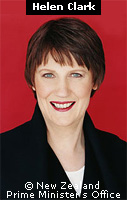
New Zealand's Prime Minister Helen Clark was in Brussels on 29 November, highlighting how, although 12,000 kilometres apart, both Wellington and Brussels are having the same conversations on staying on top in the new global economy. Speaking at a European Policy Centre (EPC) briefing, Ms Clark outlined two key challenges: how to stay competitive, and how to raise levels of innovation. Both issues are central to current EU policy discussions, and are fundamental to the EU's Lisbon strategy, which is intended to make Europe's economy the most competitive in the world by 2010. Indeed, New Zealand has its own Growth and Innovation Framework, which the government introduced in order to create the conditions for long term sustainable economic growth. The EU's strategy is therefore 'of considerable interest to New Zealand', said Ms Clark. 'A dialogue with the EU on these issues would be of value to us,' she added. New Zealand has recognised the importance of diversification for remaining competitive. While the country is likely to preserve its agrarian economy, its principal source of income, there is now more of a focus on the service industry and tourism than in the past, as well as on technology. The number of information and communication technology (ICT) exports has grown fast, and according to the Prime Minister, is expected to generate returns equal to that of the wool industry within three or four years. 'Diversifying is why we have managed to outride changes in the global economy,' Ms Clark claimed. Again mirroring the European course, New Zealand is also placing increasing emphasis on regional cooperation. Relations with many Asian countries have been intensified in recent years, and New Zealand now has a seat in ASEAN, the Association of South East Asian Nations. Ties are not purely economic however. Closer relations have led to spin offs in the form of cooperation in education and science. 'Once you start down the road of economic cooperation, there are a lot of ripple effects. Your education people start talking, your science people start talking,' she said. New Zealand's relationship with the EU has developed in a similar fashion. Ties were established some time ago, but were primarily economic. New areas of cooperation have opened up more recently, including in the areas of science, technology and education. New Zealand established the position of Science and Technology Counsellor to the EU in 2004, and an Education Counsellor will be in place in 2006. The country is also seeking to increase its involvement in the EU's research framework programmes, focusing initially on food, agriculture and biotechnology research. 'With half of non-military research being done in Europe, this cooperation is of real value to us and we believe that we have something to contribute,' she said.
Countries
New Zealand