


Lord May warns of threat to scientific progress
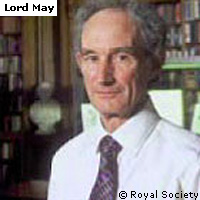
'Ahead of us lie dangerous times,' believes Lord May of Oxford, outgoing President of the UK's Royal Society. Current and future challenges for science include climate change, loss of biological diversity, and infectious diseases, he claimed on 30 November. Unfortunately, the hunt for scientific solutions is being obstructed by fundamentalism, he added. 'Sadly, for many, the response is to retreat from complexity and difficulty by embracing the darkness of fundamentalist unreason. The Enlightenment's core values, which lie at the heart of the Royal Society - free, open, unprejudiced, uninhibited questioning and enquiry; individual liberty; separation of church and State - are under serious threat from resurgent fundamentalism, West and East,' said Lord May in his final anniversary address as President of the Royal Society. Lord May detailed how this fundamentalism is hindering progress in his three priority areas. Despite evidence that climate change is a reality, exacerbated by human activity, and will have extremely serious and irreversible consequences, certain countries and industry groups have refused to acknowledge a link between human activity and the phenomenon. The US came in for strong criticism in Lord May's address. Greenhouse gas emissions are currently higher in the US than they were in 1990, and 'President George W Bush's failure to follow through on the commitments his father made on behalf of the US is underlined by his failure even to mention climate change, global warming or greenhouse gases in his 2,700-word speech when welcoming the new US Energy Act in August 2005.' The result is what Lord May calls 'a classic example of the problem or paradox of cooperation (also known as the Prisoner's Dilemma or occasionally the Tragedy of the Commons)'. The science indicates that immediate action is required in order to reduce greenhouse gas emissions, 'but unless all countries act in equitable proportions, the virtuous will be economically disadvantaged whilst all suffer the consequences of the sinners' inaction'. 'In this sense, the climate change disaster which looms this century is an appallingly large-scale experiment in the social sciences,' said Lord May. Denial is also slowing down work on minimising the loss of biological diversity. For bird and mammal species, there has been, on average, one certified extinction per year over the past century. This is already a conservative estimate, and the figure for invertebrates is likely to be even higher, although it is much harder to ascertain. Such a rate translates into an average life expectancy - from origin to extinction - of around 10,000 years. In contrast, life expectancy of species in fossil records is between one million and ten million years. Previous Ages have seen five waves of extinction. But these differ from the sixth in that this is the first to derive from human actions. In spite of the facts, biological diversity continues to be at risk. 'Fisheries are a particularly telling example of the gulf that yawns between clearly identifying a problem and taking effective action,' said Lord May. In some areas of the sea, the total weight of fish available is less than one tenth of that which was caught before the onset of industrial fishing, he claimed. 'Of course, for fisheries or other overexploited biological resources, those who are focused on the immediate gain will always depict themselves as motivated by uncertainties - real or imagined - in the science,' said Lord May. Dogma is also in conflict with science in terms of the spread of disease, and in particular sexually transmitted diseases. Referring to campaigns against condom use motivated by dogma, Lord May claimed that 'faith and belief not only override evidence, but also lead to deliberate misrepresentation of facts'. Lord May concluded his address by highlighting how the role of the Royal Society is more necessary now than at any time in the past. The Royal Society was 'born of the Enlightenment', said Lord May, and now that 'fundamentalist forces are again on the march', presence on the world stage is 'even more important today than at any time in the Royal Society's 345-year history'.