


ESA ministers emphasise European cooperation and international partnerships for space research and European competitiveness
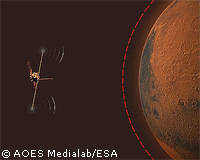
The European Space Agency's ministerial council has decided on a plan, including new initiatives as well as the continuation of current programmes, to develop scientific discovery and European competitiveness in space exploration and technology. ESA's ruling council, made up of ministers responsible for space from the agency's 17 European member states and Canada, met in Berlin on 5 and 6 December. The ministers took account of recent European economic and industrial difficulties, as well as increased global competition in all industrial sectors, including space technology and exploration. They therefore emphasised the strategic importance of a competitive space sector to provide new scientific discoveries, access to new data and services, and to maintain Europe's share of the commercial space launch and technology market. The ESA Council confirmed European cooperation as essential to reaching a critical mass of resources and capabilities in order to compete globally. They therefore decided on the further development of a European space policy involving ESA, the European Union and national and industrial research and development programmes, as well as commitment to common European initiatives, such as Global Monitoring for Environment and Security (GMES), identified by the European Space Council as a flagship project. At the same time, they noted that the space sector is changing globally. New national and industrial players, offering competitive civil and dual-use space technologies, including commercial launch capabilities, mean that working with international partners is becoming ever more important. The council took decisions on optional programmes where countries choose whether to contribute, as well as the 'Level of Resources' for 2006 to 2010 for mandatory activities, proposed at just over 3 billion euro, where all member states participate. Current programmes confirmed for continuation included the International Space Station Exploitation Programme Period 2 and Advanced Research in Telecommunications Systems (ARTES). New initiatives were also agreed upon, such as the General Support Technology Programme (GSTP), future launcher development and a Core programme for future exploration missions such as Aurora and ExoMars. European space exploration and scientific programmes, such as the recent Huygens and Mars Express missions, were seen as maintaining Europe's standard of excellence in discovery and innovation. Scientific missions were also felt to be beneficial in terms of improving public awareness of the benefits of space technologies and scientific research.