


NESTA report calls for more 'real science' in schools
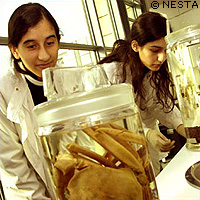
A new report by the UK national endowment for science, technology and the arts (NESTA) has called for a more hands-on approach to science teaching in schools, warning that experiments are being squeezed out due to health and safety concerns. The report, entitled Real Science, argues that scientific literacy should be placed alongside general literacy and numeracy as cornerstones of the education system. At present, however, misunderstandings over health and safety regulations and a lack of time in school curricula are acting as barriers to vital practical experimentation. 'Too often teaching and learning in science fails to convey [... the] excitement of exploring the unknown, indeed, the 'wonder of science',' argues the report. 'The continuing imbalance between content and investigation in school science tends to convey that science is only about a fixed body of known facts.' An ICM poll commissioned by NESTA in conjunction with the report supports its findings. In a survey of over 500 secondary school teachers across the UK, 64 per cent of them suggest that a lack of time in the school curricula is the biggest barrier to more hands-on science teaching, while 87 per cent say that on at least one occasion they have not let pupils carry out experiments due to uncertainty over health and safety regulations. The report goes on to make a number of recommendations for improving the current situation. It urges national policy makers to promote more effectively the opportunities for scientific enquiry that already exist within national curricula, and tackle the misapprehensions of teachers concerning health and safety risks. Funding organisations are asked to provide evidence of the effectiveness of more practical science teaching by supporting innovative initiatives and evaluating their outcome. Finally, teachers and schools are urged to network with each other in order to learn new approaches to science enquiry, and adopt best practices in science learning, for example by making links to subjects beyond the traditional science curriculum and making connections with the real lives of learners. NESTA's CEO, Jonathan Kestenbaum, said: 'In a highly technological society such as ours the ability of learners to analyse and question in a scientific manner is increasingly important. Scientific literacy now needs to take its place alongside general literacy and numeracy as a major part of the agenda to raise standards in schools.' Picking up on the report, the European Commission's website highlights an EU-funded initiative currently trying to tackle the issues raised by NESTA. The Portuguese-led 'Hands-on Science' network has partners in 30 countries, and aims to promote science and scientific literacy in schools across Europe. To achieve this, the network collects and disseminates new approaches, information, materials, ideas, curricula and experiences by monitoring previous and ongoing science education projects from across Europe, as well as gathering data on students' perception of science.
Countries
United Kingdom