


Krill provide carbon dioxide sink in Southern Ocean
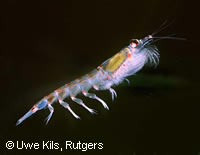
Researchers from the British Antarctic Survey (BAS) and the University of Hull have found an unlikely new carbon 'sink' in the Southern Ocean. Antarctic krill, the tiny shrimp-like crustaceans that are the favoured meal for whales, sea-birds, penguins and seals, have been shown to transfer much larger quantities of carbon from the surface to the ocean than was previously thought. In research published in the journal Current Biology, krill are shown to feed on microscopic plankton near the ocean surface and parachute to much deeper waters in the night to avoid predators. Each time this is done, the krill inject carbon dioxide into the water as they excrete their waste. The surprise is the number of times these tiny creatures do this - many times each night. Krill have long been familiar to researchers as the key link in the sea's food chain, but researchers 'had no idea their tactics to avoid being eaten could have such added benefits to the environment. By parachuting down they transport carbon which sinks ultimately to the ocean floor - an amount equivalent to the annual emissions of 35 million cars - and this makes these tiny animals much more important than we thought,' said the lead researcher on the project, Dr Geraint Tarling of the BAS. While the news of tiny creatures making this contribution may seem to be small, the sheer numbers of krill in the oceans make this a significant contribution - populations of Antarctic krill are estimated to weigh somewhere between 50 and 150 million tonnes. While the environmental benefit of krill has just been realised, the number of krill in the oceans is dropping rapidly, having declined by some 80 per cent since the 1970s. This is thought to be due to global warming, and particularly warming in sea water, which has melted much of the sea-ice in the Antarctic peninsular, thought to be a key breeding-ground as the krill feed from algae on the underside of the ice. Krill are an essential part of the food chain, swarming in gigantic numbers throughout all oceans, but most notably in the Southern Ocean. Krill are also fished commercially for aquarium food and for human consumption in Japan and Russia.
Countries
United Kingdom