


Giant leaps in the treatment of spine injuries
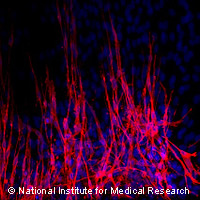
The treatment of spinal injuries is evolving so rapidly that affected people may soon face the very real prospect of effective treatment future thanks to two groundbreaking studies, both about to move to human trials. The first uses two antibodies regenerating spinal nerves in rats, while the second uses special nerve cells harvested from the nose, transplanted to the spine. Both techniques rely on the growth of nerve cells across the break to rejoin lost nerve connections. In the first study, the team from Switzerland, Canada and the Netherlands, led by Martin Schwab from the University of Zurich, used antibodies to block the action of a protein known as Nogo-A, which stops nerve cells from sprouting new axons and therefore new connections. The anticipated problem with the antibodies, known as 11C7 and 7B12, is that if Nogo-A is blocked throughout the body, then rewiring could occur in the brain or spinal cord, which would have dire consequences. The team managed to apply the antibodies to the damaged spinal cords of rats using a fine catheter. They found 'enhanced regeneration and reorganization of the injured central nervous system', after the application of the two antibodies, reads the paper, published in Annals of Neurology. This repair was due to the regrowth of axons across the damaged area by living neurons, 'resulting in improved recovery of compromised functions in the absence of dysfunctions', reads the paper. The team plans to human start clinical trials 'very soon', according to Dr Schwab. However, the antibodies alone may not provide a complete cure, as the neurons need a, 'bridge that links the lesioned nerve to the rest of the spinal cord', according to team member Lisa Schnell, talking to the New Scientist. The procedure would also require growth factors to keep the nerve cells growing and healthy. In the second independent study, Dr Geoffrey Raisman, head of the University College London Spinal Repair Unit, has pioneered work with olfactory ensheathing cells. These cells connect the nose to the brain, allowing people to smell. The cells are unique in that they regenerate throughout life. When transplanted to a broken spine, they provide a bridge for cells to reconnect. 'We've been able to restore complex reaching and control movements of the use of the forepaw [in rats] - the sort of functions that a patient would want to recover if they didn't have the use of their right hand. When we transplant the cells in that area of damage, the function comes back,' he said. The cells are used in much the same way as stem cells. The difference is that these cells are already differentiated as nerve calls, but have the stem cell-like quality of being able to grow. Dr Raisman first discovered olfactory ensheathing cells 20 years ago, but only now are there sufficiently sophisticated surgical techniques to perform the operations. The ensheathing cells can be removed from a patient under local anaesthetic, causing no permanent damage. Dr Raisman believes that the technique has far-reaching applications, from providing cures for all manner of neuronal damage, from blindness to stroke to deafness. As Dr Schwab told CORDIS news, 'Dr Raisman and I are addressing two specific solutions to two specific questions.' When asked whether the techniques developed by Dr Schwab and Dr Raisman could be used together to provide a wider solution in the future, Dr Schwab replied: 'That is definitely a possibility for the future.'
Countries
Canada, Switzerland, Netherlands, United Kingdom