


Reding launches Intelligent Car Initiative
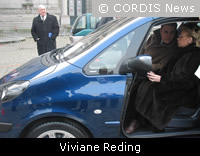
Shortly after announcing the launch of the Commission's Intelligent Car Initiative' on 23 February, Information Society and Media Commissioner Reding was herself trying out some of the latest technology for vehicles, including a car that stops by itself when it senses an object in front of it. Some 32 technologies were on display at the launch event. 'Most solutions have now been developed, but take-up is very slow,' bemoaned the Commissioner. This is principal reason for the Commission's initiative. As highlighted by Ms Reding, intelligent vehicles would enable more efficient driving with fewer delays, and reduce the number of road traffic accidents taking place. 'The intelligent car initiative is an attempt to move towards a new situation where cars don't crash any more, and traffic congestion is drastically reduced,' she said. Every year over 40,000 people die on Europe's roads, and in addition to the impact upon human lives that driving currently has, congestion costs the EU 50billion euro per year, according to the Commissioner - 0.5 per cent of GDP. By 2010 that figure could rise to one per cent, said Ms Reding. Just fitting every vehicle with eCall - the system that calls the emergency services automatically when an accident occurs - could reduce the number of fatalities by between five and ten per cent, said Ms Reding. Lateral support systems, which help drivers to change lanes, could reduce the number of accidents by 1,500 with only 0.6 per cent penetration rate. A seven per cent penetration rate would mean 14,000 fewer accidents. 'Unfortunately, despite their potential, most intelligent systems are not yet on the market, and when they are, large-scale deployment has taken a very long period of time due to several problems,' said the Commissioner. She cited the main barriers as legal and institutional constraints, as well as the extremely competitive nature of the automotive sector, the relatively high cost of intelligent systems and the consequent lack of customer demand, and the lack of information on the potential benefits of these systems. The Commission's initiative will seek to address these problems through three objectives: - coordinating and supporting the work of relevant stakeholders, citizens, the Member States and industry; - supporting research and development (R&D) in the area of smarter, cleaner and safer vehicles and facilitating the take-up of research results; - creating awareness of solutions using information and communication technologies (ICTs) in order to stimulate demand by users and increase socio-economic acceptance. The research aspects of the initiative will build upon the achievements of the EU's framework programmes for research, said Ms Reding. Under the Fifth Framework Programme (FP5), which ran from 1999 until 2002, around 100 million euro was invested in road vehicle-related research. Under FP6, which runs until the end of 2006, around 150 million euro has already been invested. 'I wish not only to continue research in this sector, but to boost it,' said the Commissioner, making an appeal to the MEPs present at the launch, who she described as 'crucial for getting EU money in a time when people talk about reducing EU spending'. Around half of the vehicles on display at the exhibition to accompany the launch were funded by EU research. The technologies on show included those for mitigating collision, for night vision, road safety in fog, vehicle-to-vehicle communication, driver hypovigilance detection and pedestrian sensing.