


Verheugen identifies good SME practice in Member States
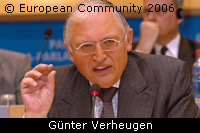
EU Enterprise and Industry Commissioner Günter Verheugen has highlighted examples of good practice in policies for small and medium sized enterprises (SMEs) at a Brussels conference. Italy, Lithuania, the UK, Spain and Denmark came in for particular praise, but other countries were also recognised for their pioneering initiatives in addressing issues such as administrative costs and access to capital. Such national initiatives are important from Mr Verheugen's point of view, because the Commission's competences are limited when it comes to supporting SMEs: 'We can only offer encouragement here, as it remains the business of the Member States and the economy to make the necessary provisions,' said the Commissioner. The EU's executive arm can, however, assemble good practices and disseminate them, he added, before alluding to three such good practices. Lithuania is planning to use model examples of successful enterprises to raise awareness of entrepreneurship among citizens. The UK is ensuring that all schoolchildren between the ages of 14 and 16 participate in courses on entrepreneurial initiatives, and Spain intends to reduce the fear of entrepreneurial failure among schoolchildren, and to decrease the related stigma, by emphasising the value of entrepreneurial initiatives. For its part, the Commission is planning a new communication on measures to ensure that a business survives when it is taken over by new owners. Every year around 700,000 businesses are handed down to the next generation, and there is a huge risk that the business may then fail, according to Mr Verheugen. The Commission already made recommendations in 1994 intended to reduce the risk of companies failing. 'After more than ten years we see that only around half of the recommendations have been implemented,' said the Commissioner. The new communication will give concrete information on what should be done in information campaigns and in the area of income tax in order to support the transfer of healthy businesses. Another proposal on access to capital for SMEs is also forthcoming, said Mr Verheugen. The May proposal will complement the previously tabled Competitiveness and Innovation Framework Programme (CIP), the better use of Structural Funds and the JEREMIE (joint European resources for micro- to medium enterprises) programme. Once again the Commissioner was able to point to national examples of good practice in this area. He referred to the Czech Republic's Kapital programme, the PreSeed programme in Finland and the UK¿s Enterprise Capital Funds, and spoke enthusiastically of Denmark's scheme to ease the tax burden for high growth enterprises that are just starting to make a profit. The scheme is valid for three years. A third Commission proposal is currently under discussion among finance ministers, and would make it easier for SMEs to establish a subsidiary in a neighbouring country by removing the law that makes them subject to that country's tax legislation. Mr Verheugen finished his presentation with a plea to Member States to raise awareness of the EU's policies for competitiveness and growth. 'A lack of information is the first reason for a lack of engagement,' he said.