


EU and Russia sign agreement on closer collaboration in space
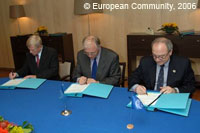
An agreement to enhance bilateral cooperation in space activities has been signed by the heads of the European and Russian space agencies, and EU Commission Vice-President Günter Verheugen. The agreement, signed on 10 March, is intended to foster closer EU-Russian collaboration in: applied technologies; access to space and space transportation systems; space science and exploration, including use of the International Space Station; and space technology development. The technology aspect of the collaboration encompasses joint activities in Earth observation; global navigation (in particular finalisation of a Galileo-GLONASS agreement), and satellite communications. Mr Verheugen, responsible for enterprise and industry policy, welcomed the agreement, saying: 'An enhanced cooperation with Russia in the space sector will have a very positive impact on the development of the European Space Programme. Working together, using existing synergies will make our space policy more effective and will bring considerable benefits for the citizens of the EU.' Co-signatories Anatoliy Perminov, head of the Federal Space Agency of the Russian Federation (Roscosmos) and Jean-Jacques Dordain, Director-General of the European Space Agency (ESA), also spoke positively of the agreement. Mr Perminov said that it is now the task of the EU and Russia 'to substantiate the programme for cooperation in the space sector and to establish a structure for an efficient coordination'. Mr Dordain claimed that the agreement will provide new opportunities for future cooperation. The agreement, to be known as the EU-Russia Dialogue on Space Cooperation, will be implemented through a mechanism that is yet to be established by the signatories. The mechanism will be used to identify potential projects and actions of mutual interest, and to coordinate their implementation in an efficient manner. In 2003, the EU and Russia agreed to create four 'common areas' for cooperation within the framework of the EU/Russia Partnership and Cooperation Agreement. One of these areas was economic cooperation, and cooperation in space was identified as a priority within this category.
Countries
Russia