


European scientists leading trips to other planets
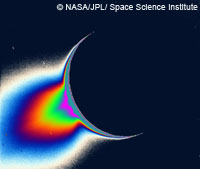
European scientists have been key to the success of the two leading explorations currently underway in the solar system - the Mars Climate Sounder , built by researchers based in the UK, has finally reached its destination Mars, and the joint European/US Cassini probe has made new discoveries about Saturn's small moon Enceladus. The Mars Climate Sounder team hopes that this will be 'third time lucky' for the satellite - the team has suffered the misfortune of two lost missions. Assuming the probe works correctly, it will send back very high quality images of the Martian landscape. 'A good way of thinking of it is it's the first Martian weather satellite,' said Professor Fred Taylor from Oxford University. 'We'll be looking at things like the temperature of the Martian atmosphere and the role of dust in the Martian greenhouse effect. We'll be looking at water vapour in the atmosphere and following the water cycle on Mars,' he told the UK's Guardian newspaper. The satellite was first conceived 25 years ago. The first probe, launched in 1992, was lost in an explosion on arrival at Mars in 1993. The second attempt made the 480 million km trip unscathed, but was then launched in the Martian atmosphere at the wrong height, due to confusion between metric and imperial measurements. Discoveries will have important implications for the way climate is evolving on the Earth. Some researchers believe that the Martian atmosphere may have resembled the Earth's many millions of years ago, feeding the search for evidence of Martian life, probably in the form of bacteria. Although the orbiter has reached the Martian atmosphere, the danger is not yet over. The probe will now have to make a series of 500 increasingly tight orbits before it reaches a circular orbit at the correct height. Once the correct orbit has been achieved - in October or November 2006 - then the two-year mission will begin in earnest. Meanwhile the Cassini orbiter continues its journey around Saturn and its moons. The international team behind Cassini has now published a series of articles in the journal Science, focusing principally on Saturn's moon Enceladus. The team's most remarkable find was that Enceladus has a type of volcanic activity. This is surprising because the moon is extremely small - approximately 500km in diameter - but has sufficient volcanic activity to produce a huge plume of what is believed to be ice, coming from a large fissure in the moon's surface, close to the southern pole. The vast plume of ice is as tall as the moon is wide. Enceladus is located in Saturn's E-ring - the ring furthest away from Saturn's surface. The Plume of material emanating from Enceladus is now thought to be the source for the E-ring, which is filled with microscopic particles of dust and ice. This has solved one of the enduring riddles about Saturn's E-ring - that it contains oxygen. The water molecules released by Enceladus are broken down into oxygen and hydrogen. However, there remains a significant mystery concerning Enceladus itself. Cassini detected signs of heat on the moon's surface, making it only the third planetary object demonstrated to emit heat after Earth and Jupiter's moon. As Enceladus is covered in ice, this indicates that the moon may even support liquid water - and possibly life? 'If we are right, we have significantly broadened the diversity of Solar System environments where we might possibly have conditions suitable for living organisms. It doesn't get any more exciting than this,' said Dr Carolyn Porco, Cassini imaging team leader at the Space Science Institute in Boulder, US, in an interview with the BBC. The plume's eruption is not constant, suggesting that perhaps Enceladus has several possible reservoirs of liquid water that erupt in the same way as a geyser on Earth. 'Even when Cassini is not flying close to Enceladus, we can detect that the plume's activity has been changing through its varying effects on the soup of electrically-charged particles that flow past the moon,' said Dr. Geraint H. Jones, from the Max Planck Institute for Solar System Research, Germany. In order to learn more, Cassini has to get closer. In 2008, Cassini will again fly past Enceladus to take an even closer look.
Countries
United Kingdom, United States