


UK Budget pledges money for green policies and Environmental Research Institute
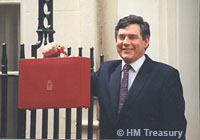
In what many British pundits see as his final budget before taking the reins from Tony Blair as the UK Prime Minister, the Chancellor of the Exchequer Gordon Brown outlined a raft of green initiatives and the setting-up of an Environmental Research Institute designed to be at 'the cutting edge of science and engineering', in his speech to the House of Commons in London on 22 March. Almost a quarter of Mr Brown's speech was devoted to research, the environment and fuel. Mr Brown's first proposal is to simplify the UK research budget: 'To make best use of the additional GBP 1.5 billion a year we invest in scientific discovery, we are today setting out plans for radically simplified allocation of the research funding that goes direct to universities.' The Chancellor also has a further GBP 180 million for 'cutting edge technologies', geared towards needs identified by the government's 'technology board', made up of British entrepreneurs. Mr Brown obliquely chastised the EU for lack of action on an EU-wide energy policy, first mooted under the UK presidency: 'Incomplete liberalisation of European energy markets is one factor in high gas prices. So at the European Council tomorrow we also propose that all energy and other sectors which fail to liberalise and open up to competition be subject to independent investigation and enforcement.' Britain's commitments under the Kyoto protocol have already been met. Mr Brown was keen to emphasise a closer relationship with the EU in this area. 'Our supply of energy should be stable, secure and competitive - and environmentally sustainable. Climate change is a global issue which demands global solutions. So our first ambition must be a long-term international framework. And I can tell the house that at the heart of this is our plan to strengthen and extend beyond 2012, the EU emissions trading scheme.' He also extended the successful climate change levy, where businesses pay for greenhouse gas emissions, so it is now linked to inflation. However, Friends of the Earth were quick to point out that the UK Government will most likely fail to meet its own revised target, set in 2002, of reducing carbon emissions by 12 million tons by 2010, and that UK emissions may even be increasing. The Chancellor outlined two schemes intended to spread sustainable development. The first is to form a World Bank fund worth USD 20 billion to finance energy efficient and renewable forms of energy in developing nations. Secondly, he outlined his desire for the UK to become a world leader in new energy technologies, and to set up 'a new energy and environmental research institute, and for it to become, for Britain, at the cutting edge of science and engineering, our aim is that public and private sectors together raise finance of one billion pounds [1.44 billion euro]. Britain must lead not only in environmental research, but in exploitation of new sciences.' To kick-start his ambitions, the Chancellor set aside GBP 20 million to spend on making UK homes and businesses 'the most energy efficient in the world', as homes produce around half of all carbon emissions. And these homes may not just be energy efficient, but also energy producers, with a further fund of, 'GBP 50 million, for microgeneration technologies which make it possible for homes and businesses to generate their own renewable energy. The purpose of this GBP 50 million fund is to show how we can make these technologies from wind turbines to solar heating, affordable to schools, housing associations, businesses including local authority tenants - initially 25,000 buildings.' For vehicles, Mr Brown has introduced a stepped duty, with nothing to pay for the most efficient vehicles, and set a target of five per cent of all fuel to be made from biofuels by 2010. Biofuels will also be cheaper - benefiting from a GBP 0.35 advantage over ordinary petrol from 2008. The ideas have broad support from Greenpeace. 'Many of these measures will make a difference if properly implemented,' said Greenpeace executive director Stephen Tindale. The UK's economy is something of an anomaly within the EU, as it has managed to maintain high growth and efficient investment in research and development. Some in the EU have argued that the EU-wide economy is in need of a UK-style makeover to stimulate growth. The recent Aho-group report listed specific measures for stimulating growth in the EU, and perhaps in this area the UK economy needs few lessons. 'In the last ten years business investment has grown on average at 5 per cent a year, compared with 3.4 per cent in the previous ten. Ten years ago British business investment was GBP 77billion. This year it is GBP 113 billion a year [...] And the Treasury expects that in the next two years business investment will grow faster than the economy at 4.5 to 5.25 per cent a year in 2007 and 2008 - rising to GBP 126 billion in 2008,' said Mr Brown. He also referred to 'the increasing dynamism and breadth of Britain's entrepreneurial culture', another of the Aho Group's targets. The budget also gives research and development tax breaks for companies with up to 500 employees, with particular emphasis on creative agencies such as film and architecture, which make up ten per cent of the UK economy. There were also measures to attract both businesses, especially in financial services, and students to the UK. Both are designed to provide long-term economic advantages. Additional breaks would be given to investing in venture capitalist trusts, which are acknowledged as stimulators of enterprise. Mr Brown also outlined a new scheme for risk-based regulation, which the UK is pioneering, 'Risk based regulation will work best if it is applied not just here, but in the European Union too. And we are asking the European council tomorrow [Thursday 23 March] to adopt the same risk based approach in the interests of Europe's global competitiveness.' The budget has received mixed reactions from the scientific community. The British Royal Society praised Mr Brown's decision to boost both maths and science in schools - Britain is acknowledged to be weak in these areas. 'The Government has clearly listened to the science community on the need for radical action in the face of the serious declines we have seen in the up take of maths, physics and chemistry after the age of 16. It must now work together with the science community if these laudable ambitions are to be achieved,' said Lord Martin Rees, President of the Royal Society. The Campaign for Science and Engineering in the UK (CaSE) was less complimentary, claiming Mr Brown had not gone far enough, 'He didn't do much to plug the massive shortage of maths and physics teachers. If the UK can't teach children basic mathematics in school, we have no chance of delivering the skilled workforce the Chancellor says he wants,' said Dr Peter Cotgreave, Director of CaSE. Both bodies gave cautious approval of the new system for funding scientific research, although Dr Cotgreave again berated Mr Brown for not reducing corporation tax to attract research investment, as has been done very successfully in Ireland. The fall-out from the budget has stimulated some excitement in the UK. Many see the questions tabled by opposition leader David Cameron in response to Mr Brown's budget speech as a preamble for future exchanges between Brown as Prime Minister and Mr Cameron. The mail criticism of Mr Brown's budget has been the absence of any information about the British National Health Service, which this week announced several hundred job cuts to save resources. The speech coincided with a publication from the Department of Trade and Industry entitled 'The Science and Innovation Framework 2004-2014: Next Steps' which has a strong focus on investment in research. 'We want this country to be the most attractive location in the world for research. [...The budget] sets out a range of exciting proposals to maximise the impact of Government investment in science on the economy, including increasing innovation, supporting excellence in university and world-class health research and enhancing the role of the Technology Strategy Board,' said Secretary of State for Trade and Industry, Alan Johnson.
Countries
United Kingdom