


Potocnik tells Serbia to get more involved in EU research
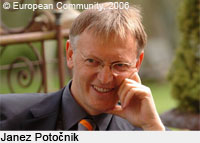
'Traditionally, scientists and ideas know no frontiers. Political obstacles have no place in the field of research,' EU Science and Research Commissioner Janez Potocnik told the Serbian scientific community in Belgrade on 14 July. The Commissioner emphasised during his address that research is one field in which Serbia can be fully integrated into the EU. He said that he would do what he can to make involvement as attractive as possible for Serbian researchers, but stressed that Serbia too must make changes in order to join the knowledge economy. 'Serbia has always had an excellent scientific tradition, and I have seen during these two days that there is a motivation and determination to maintain this reputation, making full use of your strong research base,' said Mr Potocnik. Serbia can boast Nikola Tesla (1856-1943), a world-renowned and Serbian-American inventor, physicist, mechanical engineer and electrical engineer. He is regarded as one of history's most important inventors and is well known for his contributions to the discipline of electricity and magnetism in the late 19th and early 20th century. Mihajlo Idvorski Pupin (1858-1935) was a physicist and physical chemist. He is best known for his landmark theory of modern electrical filters, as well as for his numerous patents. He invented a means of greatly extending the range of long-distance telephone communication by placing coils of wire at predetermined intervals along the transmitting wire (known as pupinisation). In modern times, 'Integration [into the EU] is an ambitious objective but research is a key tool to facilitate this. It is a policy field that opens doors and we should focus on how substantial research efforts will help us mutually to achieve this goal,' said Mr Potocnik. Research fosters closer knowledge and understanding, he added. The Commissioner assured his audience that research will help Serbia to become an effective, well functioning and dynamic state. He promised that increased knowledge would also create competitiveness, growth, employment and progress to society. 'I would like to throw the door to the European Research Area wide open. I would like to see Serbia and the other Western Balkan countries being a part of the Seventh Framework Programme as soon as possible, so that - in this domain at least - European integration becomes an early reality,' said Mr Potocnik. The Commissioner promised to do what he can to ease participation, citing in particular fair and balanced funding. But he also reminded his audience that his competences are limited in some domains - he referred to the long administrative procedures that Serbians must go through in order to apply for a visa to visit or work in an EU Member State. Various measures will soon be introduced that will ease this process, including a short-stay visa for researchers and a fast-track procedure for admitting third country researchers, he explained. However, it is not only the EU that must make changes in order to assist Serbian researchers. Mr Potocnik made it clear that he also expects the Serbian government to introduce reforms: 'Serbia needs to design an integrated research policy so that the framework conditions for research are right,' he said. In particular, Serbia must ensure that it has the right conditions for public and private sector investment in research, that it improves research capacity, attracts young people to research, makes science attractive in terms of career development, encourages partnerships between universities and institutes, and builds closer links with industry. As a 'matter of priority', Serbia must also consider how to increase the involvement of industry, and in particular small and medium sized enterprises (SMEs) in research, said the Commissioner. Mr Potocnik finished by pledging his 'personal commitment and full support' to the Serbian research community.