


ESA satellites see changes in Earth's magnetic field
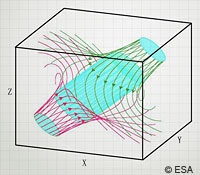
The European Space Agency's (ESA) quartet of Cluster satellites, designed to monitor changes in the Earth's magnetic field, have seen an example of 'magnetic reconfiguration' for the first time. The Cluster project aims to learn more about how the Earth's magnetic field interacts with other magnetic fields in the solar system. Those familiar with radio interference or have seen the Northern (or Southern) lights will have had first hand experience of what happens when the solar flares interact with the Earth's magnetic field. Scientists have known for some time that solar flares - huge energy releases from the sun - actively interact with the Earth's own magnetic field, changing its shape, and releasing energy. What scientists have not known is how this process appears, and what shapes the reconfigurations make. 'Identifying the structure around the point at which the magnetic field lines break and subsequently reform, known as the magnetic null point, is crucial to improving our understanding of reconnection,' reads the paper published in the journal Nature Physics. The answers are important because the magnetic reconfigurations do not just occur between the earth and solar flares, but with other, far larger celestial bodies, such as the radiation emitted by black holes. 'But owing to the inherently three-dimensional nature of this process, magnetic nulls are only detectable through measurements obtained simultaneously from at least four points in space,' reads the paper. Fortunately, the ESA Cluster satellites, known as Salsa, Samba, Tango and Rumba, can provide exactly this information. The Cluster satellites moved into position around an anticipated null point on 15 September 2001. The manoeuvre was a success, and an international team from France, Germany, the Netherlands, the UK, the US and China have been patiently number-crunching ever since. Their results reveal shapes that were not predicted. 'This characteristic size has never been reported before in observations, theory or simulations,' say team leaders Dr C. Xiao from the Chinese Academy of Sciences, Professor Pu from Peking University, and Professor Wang from Dalian University of Technology. The null point was found to be some 500 km across, and as magnetic fields interacted, they formed a spiral structure, making new connections at right angles to the original boundaries (pictured). The team now plan to study further null points to see if the shapes they have recorded are general or unique. While the research may be excellent for studying the interactions of the cosmos, the information will have specific applications on earth, in the design of nuclear fusion facilities, which will rely on a better understanding of magnetic reconfiguration in order to contain super-hot plasma.
Countries
China, Germany, France, Netherlands, United Kingdom, United States