


And it's three cheers for Venus Express!
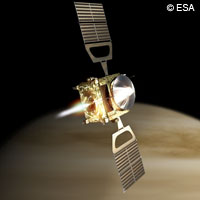
Venus Express is celebrating its first birthday and, according to the European Space Agency (ESA), the spacecraft is working well and continuing to collect lots of new data about the hot and noxious atmosphere of the planet Venus. Following a successful launch on 9 November 2005, Europe's second planetary probe made its five month journey of 415 million km towards its namesake planet, entering its orbit through a series of gradually smaller loops on 11 April 2006. By 7 May, the probe had moved into an operational position, orbiting Venus every 24 hours at a height of 250 km at pericentre and 66,000 km at apocentre, around the poles of the planet. From this height the probe began to examine Venus. 'From that time onwards this unique spacecraft, equipped with the most advanced instruments ever used for atmospheric investigations at Venus, has started gathering views and information on the thick atmosphere, its cloud system and its dynamics - during experiment tests in the beginning, and on a nominal basis after 4 June 2006,' said Håkan Svedhem, Venus Express Project Scientist. Using the very first images taken while approaching the planet, and the South Pole views obtained on 12 April - the first infrared images of this area of Venus - scientists immediately obtained novel glimpses of an extraordinarily complex weather system. No one quite knows the workings of the forces behind this weather system, which frequently causes hurricane-force winds and generates double-eyed vortices over both poles. Also unprecedented was the capturing of the double vortex over the planet's South pole. Further experiments are expected to reveal a great deal more about the planet, in many ways Earth's twin - it is a similar size, age and distance from the Sun - but which has evolved very differently. Many experts believe that Venus may have once held oceans, but if so, these have long since evaporated.