


Bringing ICT benefits to the market
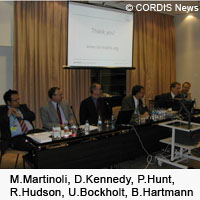
Better disseminating the results of information and communication technologies (ICT) research was the subject of a CORDIS workshop that took place at IST2006 on 23 November. The workshop, which brought together project coordinators, business people and policy makers, explored the complex nature of communicating ICT research, highlighting in particular the difficulties encountered by journalists writing about the matter, and those of project consortia when trying to select the right media channel to spread the word about their work. It also suggested a number of possible media solutions that could be used in this communication process. Looking at the problem from the perspective of the media, panellist Bernd Hartmann of MFG Baden-Württemberg presented some of the key findings of a recent survey of some 350 journalists and public relations officers in Germany. One of the main problems identified by those interviewed was the high-level of jargon and acronyms employed in press releases and other media material sent to them. 'ICT is flooded by terms which makes it very hard for a normal guy to understand,' noted Mr Hartmann. Journalists also said that they were generally wary about information they received about new products, seeing it sometimes as mere publicity for the businesses which were involved in the development process. Asked what helps them to better report on ICT, journalists underlined the importance of personal relationships: 'They want to talk to the scientists themselves in order to form their own opinion,' said Mr Hartmann, who added that journalists also like talking to third party scientific experts. Panellist Mario Martinoli, Director of YourIS.com agreed, adding: 'general media do not want to be fed press releases, it is better to provide resources from which journalists can build their own report.' He noted that the focus of any press tools should be on what the product is and not who is developing it. However, according to one member of the audience from a UK-based university, the exact opposite is also true. He found from his own experience that a press release was more likely to get picked up by the media if the sender was a university, not a small and medium-sized enterprise (SME). This was because the SME was perceived as advertising a product, while the university was showing how their research could be practically applied, he said. The participant also noted that a news item sent out in the UK has a greater uptake when it describes the research within a UK context. Meanwhile, panellist David Kennedy of the NEM Technology Platform spoke of the unreasonable pressure placed on those participating in ICT research projects in the Sixth Framework Programme (FP6) to disseminate their results. 'I am not sure this is always 100% right, since these projects are started in a pre-competitive stages,' he said. By the time the project ends, the consortia may only have a 'rough diamond', meaning a product that requires further development. So 'we [consortia] are not always in a hurry to share these results yet: we want to continue the development and have the product out first,' he said. Mr Kennedy believes that there is a contradiction between the FP6 project criteria, which obliges consortia to communicate their work, and in the evaluation process, which he says, contains no metric to assess the effectiveness of this strategy. While recognising the need for some kind of dissemination of results, for the purpose of accountability, Mr Kennedy suggested that different communication criteria should be set depending on the type of research undertaken. 'For a project which is trying to obtain consensus of opinion within a European framework, there should be a lot of discussions and dissemination of ideas. But if it's a project trying to achieve a solution in a technical area...then we are probably not going to be quite so willing to put the results in such a public domain, 'he said. As much as the workshop highlighted the problems encountered in disseminating and communicating ICT results, participants also heard of some successful experiences. Panellist Uli Bockholt of the MATRIS IST project explained how his project consortium designed its communication strategy at a very early stage, defining exactly what it would try to patent and publish, and what research and development should be kept under wraps. The consortium also worked closely with students European business schools, who were asked to read the project proposal, and make business plans about the potential market and application for their products. 'This helped our developers figure out possibilities for further development,' explained Mr Bockholt. It also helped the consortium translate the scientific point of view into a common point of view. Another success story is YourIS.com project, which produces short videos on EU funded IST projects. 'The angle of the videos we make are very social,' explained Mr Martinoli. 'The focus is not so much on what the researchers do, but how people can benefit from the research in their everyday lives.' The project has broadcast a total of 300 films across 29 European countries. Having studied some 9,000 IST projects, Mr Martinoli believes that some are more telegenic than others. 'Intrinsic technologies like that in Grids are very hard to communicate,' he said. The human angle has also been the focus of IST Results, according to its Editor-in-Chief Philip Hunt. Funded by the Commission, the portal offers a whole range of media services, including feature articles on specific projects or IST market application areas. It also features stories on new prototypes, emerging results, and research that is setting future standards. The portal is regarded as a media success, welcoming more than 150,000 visitors per month. Key to its popularity is its journalistic approach and avoidance of jargon, believes Mr Hunt.