


International team solves 248-dimensional maths puzzle
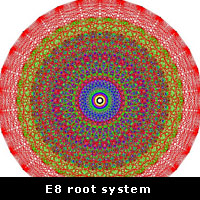
A team of European and US scientists has mapped one of the most complicated structures ever studied: the exceptional Lie group E8. This could have huge implications for understanding of algebra, geometry, number theory, quantum gravity and chemistry. Lie groups lie at the intersection of two fundamental fields of mathematics: algebra and geometry. They are named after Norwegian mathematician Sophus Lie, who studied them at the end of the 19th century. Working together in the four-year Atlas project are 18 mathematicians from France, the US and Canada. According to the American Institute of Mathematics, 'At the most basic level, the E8 calculation is an investigation of symmetry. Mathematicians invented the Lie groups to capture the essence of symmetry: underlying any symmetrical object, such as a sphere, is a Lie group.' Classical groups are described as resembling 'gentle rolling hills towards the horizon'. More complicated groups are described as 'jagged peaks', and towering above them all is E8, 'an extraordinarily complicated group'. E8 represents the symmetries of a particular 57-dimensional object, and is itself 248-dimensional. What the team has succeeded in doing is describing each of the building blocks for E8, as well as the relations between them. The matrix has 205,263,363,600 entries, and if written out in tiny print, would be large enough to cover an area the size of Manhattan. A comparison with the mapping of the human genome gives another clear indication of the sheer size of the matrix. The human genome, which contains all the genetic information of a cell, is less than a gigabyte in size. The result of the E8 calculation is 60 gigabytes in size. As with the Human Genome Project, the full implications of the mapping will not be known for many years. 'This is basic research which will have many implications, most of which we don't understand yet. Just as the human genome does not instantly give you a new miracle drug, our results are a basic tool which people will use to advance research in other areas,' said project leader Jeffrey Adams. Hermann Nicolai, Director of the Albert Einstein Institute in Bonn, Germany, explained the importance of the achievement for physics. Physicists have come across E8 much more recently than mathematicians, but encounter it regularly in attempts to unify gravity with other fundamental forces into a consistent theory of quantum gravity. 'Thus, understanding the inner workings of E8 is not only a great advance for pure mathematics, but may also help physicists in their quest for a unified theory.'
Countries
Canada, France, United States