


Europe and Russia to simulate Mars mission with 500-day experiment
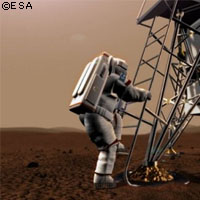
A crew of six will carry out a 500-day simulated mission to Mars in early 2008. The mission is being organised by the Russian Institute for Biomedical Problems (IBMP), and involves the European Space Agency (ESA), Roscosmos and the Russian Academy of Sciences. The crew will experience a simulated launch, a 250-day outward journey, arrival at Mars, an excursion to the surface and the long journey back to Earth. But instead of living in a spacecraft for 500 days, the crew will be housed in a series of metal tanks in Moscow. Using narrow connecting passages they will be able to move between a medical area, a research area, a crew compartment and a kitchen - a total area of 200 square metres. The simulation will be used to investigate the psychological and medical aspects of such a long mission, and the crew will also be asked to conduct experiments. ESA is now asking for proposals for appropriate experiments. These could address the influence of confinement on sleep, mood and mental health, the impacts of different personalities, cultural background and motivation levels, physiological adaptation to an isolated environment, the effects of stress on health, and changes to the immune system. All proposals will undergo peer review. 'We want to look at the psychological effects of the situation on your mental well-being, and on your capabilities of performing certain tasks, even tasks critical to the mission,' says ESA scientist Marc Heppener. 'How will group relations evolve? What are the potential dangers we could encounter? What kind of countermeasures can we invent that can prevent this? For us we can also learn about what types of personality we should select for a real mission,' he explains. The mission is to be known as Mars500. ESA's participation in the project will be detailed in a contract that is currently under negotiation. ESA will be proposing two of the six crew members, and will also be fully involved in the definition of the mission, including the steering boards, medical boards, and the operations team on the outside of the Moscow facility. 'That is also very important for us,' says Dr Heppener. 'We have experience in having astronauts flying on the International Space Station, but having astronauts travelling to Mars is a whole different ball game.' A call for volunteers will be launched in mid-June, and Dr Heppener expects ESA to have made their selection by November 2007. Meanwhile ESA strengthened its links with another space power - NASA (the US National Aeronautics and Space Administration) - on 21 March. The Agencies' new Network and Operations Cross-Support agreement covers the mutual provision of services for missions where no specific Memorandum of Understanding is in place, typically due to the short-term nature or limited scope of the support. The agreement covers tracking, navigation and systems sharing, and in particular: - bi-directional telemetry, tracking and command services; - space navigation, including services such as determining spacecraft trajectories and Very Long Baseline Interferometer services; - mission operations and ground data systems services. 'The agreement means ESA and NASA can provide each other network support and space operations services more quickly, and this is becoming very significant,' said Head of ESA's Mission Operations Department, Manfred Warhaut. 'The sharing of resources is a sensible and efficient way to achieve enhanced space science value in an era of tight budgets.'
Countries
Russia