


Groundbreaking research by Maltese academics hits the headlines
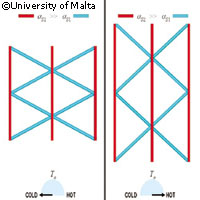
Maltese scientists are celebrating as their groundbreaking work on developing a way of reducing the impact of thermal expansion attracted the interest of the international scientific press. Following the publication of their research results in this week's Proceedings of the Royal Society A, the respected New Scientist magazine, which promotes important scientific discoveries likely to impact society, took up the story as one of its breaking news items on its website. This was a cause to celebrate for the smallest EU country in terms of both population and area. The team of scientists from the University of Malta had worked on negative thermal expansion, successfully developing a way of designing structures, of any size, that shrink when heated. Their work was funded by the Malta Council for Science and Technology (MCST) and the EU-funded project, CHISMACOMB. It could be applied to reduce the impact of thermal expansion on anything ranging from bridges to microscopic systems. 'The University of Malta is gradually building an infrastructure to conduct world-class research in niche areas of engineering, science and medicine,' said Juanito Camilleri, the rector at the University of Malta. 'Though we do not have a long-standing tradition of institutional research, and despite the very modest funds to sustain such endeavours, our up-and-coming researchers have shown, time and again, through their publications, that they can put us on the international map of scientific and technological innovation,' he added. The team of scientists studied triangles with at least one side made from a different material to the others, connected by rotating joints. They found that the diverse materials would change volume in response to temperature in a different way. The triangles would actually shrink in one direction when heated. The researchers then derived equations that describe the behaviour of their triangle-framework system as these are essential to predicting the response to temperature of their structure. So the mathematical model makes it possible to choose exactly how such a structure behaves. The coordinator of the project, Joseph N. Grima, and his colleagues believe the lattices of the triangles could have all kinds of applications. 'We have shown that it is possible to easily design systems that exhibit a tailor-made response to temperature,' he said. 'These systems could be constructed very cheaply and could be as big as a bridge or on a microscopic scale' he concluded.
Countries
Malta