


Winners of EU contest for young scientists announced
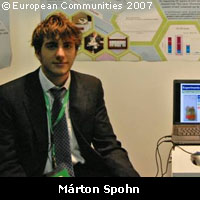
Sparkling water droplets, perfumed plants and data encryption are the topics of the winning entries in the 19th European Union Contest for Young Scientists. The three winning teams each received prizes of EUR 5,000 from José Manuel Silva Rodriguez, the European Commission's Director-General for Research. The contest is part of the EU's Science in Society programme, and was set up with the aim of encouraging young people to pursue their interest in science and embark on scientific careers. This year's competition, which was held in Valencia, Spain, attracted 81 entries from 30 countries from across Europe, as well as China and the US. All the teams participating in the contest had already won a national science competition. Aged between 14 and 20, the young scientists covered a wide range of disciplines, including astronomy, earth sciences, biology and social sciences. The entries were judged by an international panel of 15 experts. 'If there are two crucial elements of Europe's future, it's our young people and our research ability,' said Janez Potocnik, European Science and Research Commissioner. 'So it's very heartening to see the interest from around the world in this Contest for Young Scientists, as well as the many innovative ideas on display. I hope that your success in being selected for this contest will encourage you to continue on your journey of invention and discovery.' Winners Florian Ostermaier (19) and Henrike Wilms (20) of Germany first became interested in the properties of water droplets during a trip to a cave. They noticed that every time a drop fell from a stalactite, it appeared to flash at a certain height. Experiments with a dripping tap revealed the conditions under which these flashes occur. 'In addition to that we succeeded in describing the phenomenon mathematically and we know now that the light reflections within a falling droplet change because the droplet itself oscillates,' they write in their entry. The budding physicists note that the phenomenon can be observed wherever a drop detaches itself from a surface, including in the shower or from a gutter. Another winner was Márton Spohn, an 18 year old from Hungary, who studied plants that defend themselves from pests by emitting a scent which attracts the natural predators of the pest. 'This phenomenon was studied by biologists and chemists, but a contradiction remained unnoticed: [the] chemicals that are held responsible directly for this effect cannot evaporate,' Mr Spohn writes in his entry. Experiments with plant extracts revealed how these chemicals are turned into compounds which can evaporate and waft through the air to attract the pests' predators. Mr Spohn hopes his work will lead to the development of more environmentally friendly pesticides. The third winner of a top prize was 16 year old Abdusalam Abubakar from Ireland. His project involved RSA encryption, which uses a public and private key to encrypt data sent over the internet, for example. Mr Abubakar built on previous work by other scientists to show when an encrypted message could, in theory, be attacked. In addition to a top prize in the general contest, the German and Hungarian winners were each awarded a 'Stockholm International Youth Science Seminar' honorary award, which involves a trip to Stockholm to attend the Nobel Prize ceremonies and meet the Nobel Laureates. Mr Abubakar topped up his first prize with a 'London International Youth Science Forum' award, which will give him the chance to take part in a two-week intensive summer science festival and meet other young scientists from around the world. The outlook for the three winning teams is good; according to the Commission. Previous participants have gone on to achieve major scientific breakthroughs and many have successfully marketed the ideas developed for the contest.
Countries
Spain