


Saving water - it's a game
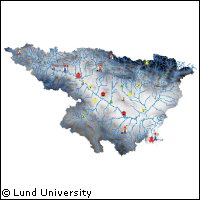
With the help of a computer game, Swedish, Dutch and Spanish researchers want to further understanding of sustainable water use. The game is part of the EU-funded Methods and Tools for Integrated Sustainability Assessment (MATISSE) project. The players act in a world with a river running through a landscape. The scenario, which is based on geographic information from the region along the Ebro River in Northern Spain, incorporates different water users, cities, villages, farms, vegetation, rain and frogs - representing 'voiceless water users'. Spain is suffering from severe water shortage. When the water in the Ebro wanes, it not only affects power companies that have built power turbines along the river and local villagers, but also people and natural and cultural treasures. Before the game begins, players have to answer a questionnaire, giving themselves an identity - including who they are, where they live along the river, and so on. They will then pop up as a dot in the playing field, where they can start to dig a field or irrigate it. Players can see what other players are doing as well as the results of their own and others' actions with regard to the water cycle. In this way, stakeholders along the Ebro River can better assess the impact of what they do, ecotoxicologist and water expert Göran Ewald of Lund University's Centre for Sustainability Studies told CORDIS News. At the same time, problem stakeholders may be identified. 'We often lack methods for reaching agreement about a solution that everyone can accept,' Mr Ewald pointed out. 'And this is where the game comes in', promoting mutual understanding and knowledge. However, the game is not a mere simulation of the water cycle, it can also be considered as a democratic tool: 'If we put both [water and democracy] in the context of sustainable development, water is the basis for everything and democracy is the basis for what people will accept' with a view to authorities' decisions, Mr Ewald explained. As a result, the game might help people from the Ebro region to trust the authorities and institutions. A first test showed that subjects responded very well to the game. A second test round is scheduled for February 2008. Eventually, the researchers intend to make the game publically available on the internet, said Mr Ewald. The MATISSE project as a whole is supported by the EU's Sixth Framework Programme (FP6) as part of the global change and ecosystems priority area. With sustainable development being one of the EU's most important policy objectives, the 26 project partners from 10 countries and various fields of research hope to make some headway in the science and application of Integrated Sustainability Assessment (ISA) policies. This includes the development of a common conceptual ISA framework, a portfolio of future tools, which will undergo testing in a number of case studies, and a set of guidelines for ISA.