


Global perspective and cooperation vital for ERA, says ESF CEO
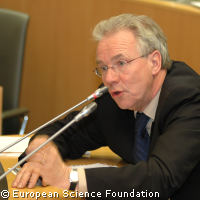
'I think the word GLOREA [Global Research Area], which was first coined by the ESF in its response to the Green Paper, has now become a word with a meaning and a context,' Dr John Marks, the CEO of the European Science Foundation (ESF), has told CORDIS News. 'When you think about organising science from the perspective of making progress in science, the global dimension comes in immediately, as it is about the importance of cooperation between scientists, with each of them doing their part in the global scientific endeavour,' he added. Dr Marks was speaking on the last day of the ESF's first ever science policy conference on the European Research Area. According to the Doctor in Physics, when it comes to innovation, frontier research or addressing specific societal problems such as climate change or emerging diseases, it is 'old hat' to let national or even European priorities determine the type of investments in science. Global cooperation between scientists from a broad spectrum of scientific disciplines is needed as 'answers demand collaboration of the best groups, which are not necessarily only in Europe, let alone in a single country'. In addition, there is also the question of the increasing role of expensive research infrastructures. From the fusion power project ITER, which brings together seven national and supranational parties, to CERN, the world's largest particle physics laboratory, for Dr Marks these are clear examples of the global dimension of research infrastructures. Moreover, networks of smaller equipment or databases are increasingly becoming indispensable. He points to the distributed database of the European Social Survey as an example, or the global observing systems for climate change research as another. But there is more to it than that says the physicist. The international dimension of the European Research Area has been mostly approached from the politico-economic perspective of competition between Europe and the US and Japan. For the scientific community, on the other hand, creating the best conditions for excellence and for advancing frontiers in science is another, far more interesting, perspective. So while the rise of developing countries such as China, India and Korea are seen as a threat in economic terms, 'from a scientific perspective, it is an opportunity for more intensive cooperation'. 'Strengthening European science will make Europe a more attractive partner. But we need to work at it. While we have excellent researchers, we lack the conditions that allow them to perform, which is where the ERA could help. And we want an environment that encourages foreign teams to work with the best teams that Europe can mobilise, independent of the country in which team members work, which is where Europe's contribution to a GLOREA could help,' explains Dr Marks. As is often heard in European science policy circles, the fragmented European scientific landscape is the barrier. Hence the current debate on building the European Research Area launched by the European Commission this year. For Dr Marks, 'Europe presents a rich but fragmented picture. Joining the forces of national agencies in Europe together through the ERA would make European science more accessible and hence more attractive as a partner for cooperation. 'Creating the ERA is not something that can be left to either the Commission or to governments. The ERA is a joint responsibility of all organisations dealing with science in Europe, acting in partnership,' he concludes.