


Danish Space Centre wins multi-million Euro order for 'Swarm' satellite mission
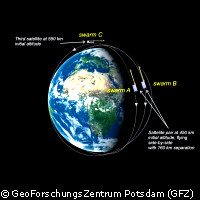
The Danish National Space Centre has won a multi-million Euro order to deliver high-tech instruments for the European Space Agency's satellite mission 'Swarm'. The mission will consist of three satellites which are to orbit 400-500 km above the earth for four years, mapping out its magnetic field with record accuracy. The objective of the Swarm mission is to provide the best ever survey of the geomagnetic field and its temporal evolution, in order to gain new insights into the Earth system by improving our knowledge of the Earth's interior and climate. To accomplish its goals, the mission will be carried out by the European Space Agency (ESA), while the Danish National Space Centre will be responsible for the project's scientific management and building the all-important measuring instruments for the three satellites. These instruments, called vector magnetometers, will enable measurements of the magnetic field to be taken over different regions of the Earth simultaneously. The geomagnetic field models resulting from the multi-satellite Swarm mission are expected to further our understanding of atmospheric processes related to climate and weather and will also have practical applications in many different areas, such as space weather and radiation hazards. 'The advanced Danish space technology on the Swarm mission will give scientists a new and improved understanding of the Earth's magnetic field and its changes,' says Nils Olsen, senior researcher at the Danish National Space Centre. The timing is perfect, says the engineer, as big changes are currently taking place in the Earth's magnetic field. 'The magnetic north pole is moving with considerably higher speed than ever measured before, and over the south Atlantic, the magnetic field has become much weaker in the course of the last decades. The Swarm satellites will be able to determine what is going on in the fluid core of the Earth, where the magnetic field is created, and they will also be able to study what effect this is having on the space environment surrounding the Earth,' he explains. According to current plans, the satellites are scheduled for a launch in 2010.
Countries
Denmark