


Potocnik calls for process to modernise universities to begin
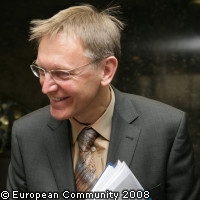
In order to move towards a knowledge-based society, European universities must embark on a process of modernisation, says European Science Commissioner Janez Potocnik. Speaking to participants at a colloquium of the French Conference of University Presidents (CPU) in Brussels on 4 April, the Commissioner welcomed recent changes to French law giving greater autonomy to universities. '[Your new law] is a response to many of the hurdles identified by the Commission in recent years, and where we have called on the Member States and the universities to act,' said Mr Potocnik. 'It is also an example to Europe as a whole, where we need to make progress in giving our universities more autonomy in the management of their interlinked missions of teaching, research, innovation and knowledge transfer,' he added. But modernising universities Europe-wide is not as straightforward as it sounds, and requires a number of important steps. The first is increasing the supply of competent researchers with high levels of mobility across geographical borders and between institutions, disciplines and sectors. This could be achieved in part, suggested the Commissioner, by advancing the reform of doctoral programmes as foreseen within the Bologna process. 'While the central mission of teaching and commitment to basic science must be preserved, globalisation demands that universities play an expanded role in innovation and economic development,' noted Mr Potocnik. Another imperative, therefore, is the development of stronger links with industry and a greater exchange of knowledge with the business community. Universities should also be given greater freedom in defining individual strategies for research, teaching, collaboration and promotion in selected fields of excellence. This will open up the way for greater diversity among the higher education institutions, believes the Commissioner. 'Let me be clear that I'm not talking about a 'one-size-fits all' model. On the contrary, I'm against standardisation or compulsion,' he added. Another important step includes encouraging all ages to continue with their education. 'Europe needs to attract many more young people to scientific studies and careers and retain them, particularly female researchers. Universities also have a major part to play in making life-long learning available to Europe's workforce, by offering the training that is in demand by business and wider society,' noted Mr Potocnik. While the European Commission is not a direct actor in the modernisation of universities, said the Commissioner, it will provide support in a number of areas to catalyse the process. To implement the modernisation agenda, it will call for coordinated action from Member States to invest more and create the appropriate frameworks that support greater university autonomy and accountability. Universities themselves will also be asked to make strategic choices and to conduct internal reforms. For its part, the Commission will support the policy dialogue and 'mutual learning'. Some of these areas are further highlighted in the Green Paper on the European Research Area (ERA), which was published last year. The document underwent intensive scrutiny by all actors concerned, including universities. As a follow-up to the debate and consultation, 2008 will see the adoption by the Commission of five specific initiatives: - a framework to help Member States to develop joint public research programmes. These activities will be on a voluntary basis and allow 'variable geometries'; - a partnership for a European researchers' passport for mobility and career development; - an appropriate legal framework for pan-European research infrastructures; - a Commission recommendation and a 'code of practice' on the management of intellectual property rights in public research; - and a common strategy for international science and technology cooperation for the Community and Member States. 'All of them will affect Europe's universities and will widen the possibilities for your success. So I encourage you to take advantage of them,' concluded Mr Potocnik.
Countries
France