


A flight glitch: how Asian birds make their way to Europe
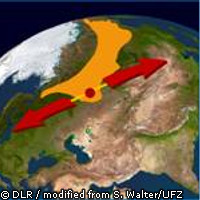
Many species of birds migrate to other parts of the world to find food or a safe place to breed. However, some species of birds get lost on their way. According to a study by a team of researchers from Germany's University of Marburg, the Ornithological Society in Bavaria, and the Helmholtz Centre for Environmental Research (UFZ), birds stray because of an error in their genetic migratory programme. The findings are published in the Journal of Ornithology. The research team examined the body mass, wingspan, size of breeding area, distance between the breeding area and the wintering area, and the distance between the breeding area and central Europe for 38 species of migratory birds. Their work included an assessment of reports of Asians birds, from the thrush (Zoothera) and leaf-warbler (Phylloscopus) families, which had strayed to Europe. Contrary to what was previously thought, the researchers discovered that these vagrant birds were not misreading the distance they had to fly. They found that the distance between the breeding grounds in northern Siberia and the wintering sites in southern Asia was similar in lengthen to the distance between the breeding grounds and Europe, where the birds ended up. In fact, the greater the similarities are between distances and the more numerous a particular species is, heightens the chances of that species going astray, the researchers found. Body size coupled with adverse weather conditions have also been blamed for causing migratory birds to fly off course. However, the researchers say that the incidence of smaller vagrant birds compared to larger ones would have been greater if the issue of body size was true. So why do vagrants exist? A bird's flight direction and flight duration are passed on from one generation to the next. This means that migration is the result of a genetic programme, through which bird populations have adjusted to environmental conditions. However, migratory birds can adapt to changes in environmental conditions over just a few generations. Their genes are responsible for the migratory restlessness that drives most of them thousands of kilometres to their winter quarters. Nevertheless, for a long time people were puzzled as to why individual birds of certain species repeatedly went astray. 'In these cases, errors have simply occurred in their genetic programming that, if you like, make the birds turn right instead of left,' explains Robert Pfeifer, the secretary general of the Ornithological Society in Bavaria. 'The vagrants can be compared to people who drive the wrong way down the motorway - they fly the wrong way down the intercontinental migration flyway.' Mr Pfeifer adds that a return back home is not on the cards for most of these birds. 'Although there are indications that individual birds attempt to overwinter in southern Europe, none of them are likely to make the return journey to Asia,' he says. The Asian birds that use central Europe as a landing pad are as common in Asia as are their relatives, the leaf-warbler Chiffchaff (Phylloscopus collybita), in Europe. 'The more numerous a species is, the greater the probability that one of them will be 'wrongly programmed' and go astray,' says Dr Jutta Stadler of the Helmholtz Centre for Environmental Research (UFZ). 'They fly the same distance but in the opposite direction, which takes them to Europe. This is why we have relatively large numbers of vagrants from Asia here.' The researchers used as a source the list of confirmed sightings from a handbook on birds of Central Europe, from the start of ornithological records to the early 1990s.
Countries
Germany