


EU satellite back on track for lift-off
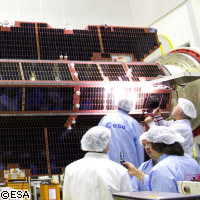
The European Space Agency's Gravity field and steady-state Ocean Circulation Explorer (GOCE) is back on track for its launch into space on September 10 2008 after its first launch date was postponed. The initial postponement was made as a precautionary measure after a malfunction of an upper-stage section of a Russian Proton Launcher. This postponement led to the satellite being reconfigured into a summer launch configuration. Now, less than two months away, GOCE is ready to be shipped from the ESA's test facilities in the Netherlands to the Plesetsk Cosmodrome in northern Russia. The GOCE satellite, dubbed the Formula 1 of spacecraft, has been developed to increase our level of understanding of one of the Earth's most fundamental forces of nature: its gravity field. This will be done through an Electrostatic Gravity Gradiometer (EGG) it will carry onboard. Though we cannot see it, gravity is a complex force that has a huge impact on our everyday lives. You may have learnt at school that the force of gravity on the surface of the Earth has a constant value. This however is not the case; in fact, the value of 'g' varies subtly from place to place. Why do these variations occur? Well, these variations are often due to a number of factors, including the rotation of the Earth, the position of mountains and ocean trenches and variations in density of the Earth's interior. It is expected that GOCE will be in orbit for at least 20 months; during this time, it will map these global variations in gravity with extreme detail and accuracy. The mapping survey of the gravity will be used to create a unique model of the geoid - the surface of equal gravitational potential defined by the gravity field. These measurements are crucial for developing accurate measurements of ocean circulation and sea-level change, both of which are affected by climate change. The data retrieved from GOCE will also help scientists around the world understand more about processes occurring inside the Earth, and will be used in practical applications such as surveying and levelling. The satellite's alias of Formula 1 comes from the sleek design of the spacecraft. With an arrow shape and stabiliser fins, it will race through the air at an altitude of 263 km. Its flight path will put it at a slight inclination with respect to an exact polar orbit. This means that the satellite will go into the shadow of the Earth during polar nights for 28 minutes 135 days each year. In so doing, GOCE will experience changes in temperature that could potentially affect measurements. Not knowing exactly when GOCE would launch, the option to choose whether it went into Earth's shadow, referred to as an 'eclipse period', between October and February or between April and August was included in its design. Since GOCE will be launched in September, the preferred eclipse period is April to August, because this allows unaffected commissioning and science operations until April next year. The GOCE satellite will leave Schiphol Airport near Amsterdam in the Netherlands and be flown to Arkhangelsk, Russia on an Antonov cargo aircraft -the largest flying airplane ever built. From Arkhangelsk, it will be taken south to the Plesetsk Cosmodrome by train.