


IFM-GEOMAR takes delivery of new ROV
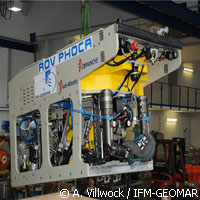
Scientists at the Kiel Leibniz Institute for Marine Sciences (IFM-GEOMAR) in Germany have a new piece of kit to work with - a remotely operated vehicle (ROV) called PHOCA (from the Latin for 'seal'). The submersible, which cost EUR 1.2 million and weighs 1.5 tonnes, can work down to depths of 3,000 metres. PHOCA's first task at IFM-GEOMAR will be to install and maintain the institute's new deep-sea laboratory MoLab ('Modular multidisciplinary seafloor observatory'). 'We are very happy about this accession. With these new capabilities which PHOCA offers, we will be able to fulfil our scientific duty far more flexible than before,' commented IFM-GEOMAR director Professor Peter Herzig. 'The technical equipment of the IFM-GEOMAR especially regarding large instruments designated for deep-sea deployment is one of the most modern in Europe.' With its small size (it is just over 2 m long), PHOCA is well suited to deployment from medium-sized research vessels. PHOCA's two manipulators allow researchers to carry out diverse sampling procedures, while digital video cameras allow scientists to see what is happening in the depths of the ocean and to chart the sea floor. Furthermore, the device has a payload of up to 100 kilograms (kg), meaning it can carry additional scientific equipment if needed. According to IFM-GEOMAR's Dr Olaf Pfannkuche, head of the institute's Technology and Logistics Centre, 'It's like having grown new arms and eyes for investigating the deep sea.' Data is transmitted to the surface in real time. The device works in what the researchers call 'live-boating mode'. This means that it is linked directly to the ship via a steel-armoured optical fibre cable. IFM-GEOMAR already has one ROV, the ROV KIEL 6000, which has been in use since 2007. PHOCA can use the same winches and umbilicals as KIEL 6000, and PHOCA's two manipulators are of the same kind as KIEL 6000's. From a practical point of view, this means that it will be easier for IFM-GEOMAR staff to learn to use and maintain PHOCA. PHOCA's first task at IFM-GEOMAR will be the installation and maintenance of the institute's sea floor observatory, MoLab; this work is scheduled to begin in spring 2011. 'Two thirds of the earth's surface are basically unknown to us as they are covered by oceans with depths of several kilometres,' said Dr Pfannkuche, who is also the coordinator of the MoLab project. 'If we want to understand the functioning of the earth, we need to monitor these two thirds more intensely and on a long-term time scale. MoLab is an important step into this direction.' MoLab comprises a range of different scientific instruments designed to measure different biological, physical, chemical and geological aspects of the sea floor over an area of several square kilometres and for periods of several months. The EUR 3.16 million project is funded by the German Ministry of Education and Research (BMBF). In a statement, IFM-GEOMAR explains: 'The great advantage of MoLab is that it may be deployed, maintained and recovered using medium-sized research vessels such as RV POSEIDON of the IFM-GEOMAR. Furthermore, the system is flexible and may thus be moved to different working areas or adapted to different scientific tasks within short time.' PHOCA was manufactured by UK company Sub-Atlantic.For more information, please visit: Leibniz Institute of Marine Sciences (IFM-GEOMAR):http://www.ifm-geomar.de Sub-Atlantic:http://www.sub-atlantic.co.uk/
Countries
Germany