


Switching gears: getting to know black holes better
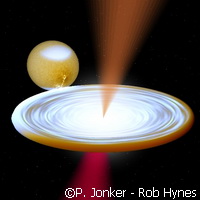
Black holes are extremely powerful and efficient engines that swallow up matter and return a lot of energy to the Universe in exchange for the mass they eat. When they attract mass they also trigger the release of intense X-ray radiation and power-strong jets. However, not all black holes do this the same way, something that has long puzzled space-gazers. Now, findings from researchers at the SRON Netherlands Institute for Space Research suggest that each black hole can change between two different 'settings' to carry out this task, much like when a driver changes the gears of a car engine. Black hole jets are lighthouse-like beams of material that race outwards at close to the speed of light; they can have a major impact on the evolution of their environment. For example, jets from the super-massive black holes found at the centre of galaxies can blow huge bubbles in and heat up the gas found in clusters of galaxies. Peter Jonker and Eva Ratti set out to study two active black holes with the aim of investigating the connection between the X-ray emission from a black hole and its jet outflow, a connection discovered by astronomers in 2003. Understanding this connection is crucial to explaining how the black hole engine works. At first, astronomers though this connection was the same for all feeding black holes, but soon exceptions were discovered; these unusual examples still exemplified a clear connection between the energy released in the X-ray emission and that put in the jet ejection. However, it was clear that the proportion differed from that in the 'standard' black holes. As more exceptions were spotted, it started to appear that there were two groups of black hole engines working in a slightly different way. The Dutch researchers' new work builds on studies carried out by astronomer Michael Coriat, based at the University of Southampton, who found a black hole that seemed to switch between the two types of X-ray/jet connection, depending on its brightness. This suggested that black holes do not necessarily come with two different 'engines', but that each black hole can run in two different ways from the same engine. They used X-ray observations from the Chandra X-ray Observatory and radio observations from the Expanded Very Large Array (EVLA) in New Mexico to observe the two black hole systems more closely. Eva Ratti comments: 'We found that these two black holes could also "change gear", demonstrating that this is not an exceptional property of one peculiar black hole. Our work suggests that changing gear might be common among black holes. We also found that the switch between gears happens at a similar X-ray luminosity for all the three black holes.'For more information, please visit: Royal Astronomical Society (RAS):http://www.ras.org.uk/
Countries
United Kingdom