


Getting closer to distant dark galaxies
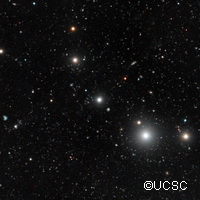
An international team of scientists has finally spotted far off dark galaxies, the small, gas-rich galaxies in the early Universe that are very inefficient at forming stars. As they are devoid of stars, these dark galaxies don't emit much light, making them very hard to detect. Although small absorption dips in the spectra of background sources of light have hinted at their existence, astronomers have long sought to develop effective techniques that could once and for all confirm their existence. But now, the team, made up of astronomers from Switzerland, the United Kingdom and the United States, has confirmed the existence of these galaxies using a special technique. Their study, published in the Monthly Notices of the Royal Astronomical Society, marks the first time that such objects have been seen directly. These galaxies are thought to be the building blocks of today's bright, star-filled galaxies and they could have fed large galaxies with much of the gas that later formed into the stars that exist today. Co-author of the new study Simon Lilly from ETH Zurich in Switzerland explains: 'Our approach to the problem of detecting a dark galaxy was simply to shine a bright light on it. We searched for the fluorescent glow of the gas in dark galaxies when they are illuminated by the ultraviolet light from a nearby and very bright quasar. The light from the quasar makes the dark galaxies light up in a process similar to how white clothes are illuminated by ultraviolet lamps in a night club.' Some very long exposures and the large collecting area and sensitivity of the Very Large Telescope (VLT), operated by the European Southern Observatory (ESO) on Cerro Paranal in the Atacama Desert of northern Chile, helped the team detect the extremely faint fluorescent glow of the dark galaxies. They mapped a region of the sky around HE 0109-3518, a bright quasar (a very energetic and distant active galactic nucleus), looking for the ultraviolet light that is emitted by hydrogen gas when it is subjected to intense radiation. By the time it reaches the VLT this light is actually observed as a shade of violet due to the expansion of the Universe. Lead study author Sebastiano Cantalupo from the University of California, Santa Cruz says: 'After several years of attempts to detect fluorescent emission from dark galaxies, our results demonstrate the potential of our method to discover and study these fascinating and previously invisible objects.' The team detected almost 100 gaseous objects which lie within a few million light years of the quasar. After carefully analysing where the emission might be powered by internal star formation in the galaxies, rather than the light from the quasar, they finally narrowed down their search to 12 objects. These are the most convincing identifications of dark galaxies in the early Universe to date. The astronomers were also able to determine some of the properties of the dark galaxies. They estimate that the mass of the gas in them is about 1 billion times that of the Sun. Sebastiano Cantalupo adds: 'Our observations with the VLT have provided evidence for the existence of compact and isolated dark clouds. With this study, we've made a crucial step towards revealing and understanding the obscure early stages of galaxy formation and how galaxies acquired their gas.'For more information, please visit:European Southern Observatory (ESO):http://www.eso.org
Countries
Switzerland, United Kingdom, United States