How diatoms (the ocean’s ‘jewels’) reveal our climate past, and future

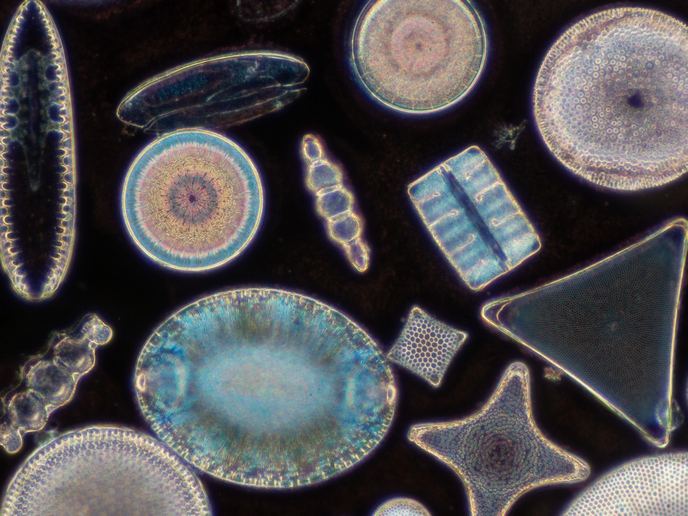
Diatoms are the most diverse and abundant group of microscopic plants known as phytoplankton. According to Chris Bowler(opens in new window) from the IBENS(opens in new window) research institute, despite their diminutive size, diatoms are responsible for a fifth of the planet’s photosynthesis – equivalent to all the land’s tropical rain forests! Their most striking characteristic is a glass (silica) cell wall and an extraordinary range of shapes and sizes, akin to jewels. Because different species are exquisitely adapted to specific environmental conditions, they reveal much about climate change adaptation. “While we knew their importance to ocean ecosystems, we lacked an adequate overview of their global diversity and abundance relative to other phytoplankton groups,” explains Chris Bowler, coordinator of the DIATOMIC project, which was funded by the European Research Council(opens in new window). To attempt such an overview, Bowler leveraged the Tara Ocean dataset(opens in new window), derived from a 4-year global sampling campaign which he helped coordinate. “This dataset has become the gold standard for ocean genomics. Enabling thousands of scientific publications, it is the first resource of its kind to help scientists explore plankton distributions and evolutionary adaptations,” notes Bowler.
Developing methods to extract ancient marine sediment DNA
Tara Ocean developed a database of 40 000 plankton types sampled from the global ocean’s surface to depths of 1 000 metres, to which standardised analytical methods, including DNA sequencing and microscopy, can be applied. DIATOMIC wanted to develop a census of diatom diversity and abundance in today’s ocean and use it to explore past changes in diatom communities in response to environmental changes, such as the last ice age. “We are trying to catch evolution red-handed,” Bowler says. The project focused on a genus called Chaetoceros, as the most abundant and cosmopolitan diatom genus. As some species make long-lived resting spores which are retrievable from marine sediments for the extraction of DNA, they represent ancient populations. Well-established palaeoindicators – related to changes in temperature, seasonality, ice cover and marine productivity (photosynthesis) – were correlated with changes such as population shifts and key gene mutations. The Arctic and Antarctic were of special interest due to their dramatic climatic changes over time. Analyses of Antarctic Peninsula sediment cores covering 10 000 years revealed major changes in temperature, ice cover and seasonality, alongside well-preserved diatom microfossils. Extracting ancient DNA enabled morphological data to be matched with genetic data, evidencing how population shifts occurred in response to environmental changes. Genetic information also revealed changes in the genes that encoded proteins for thermal adaptations, alongside the selection of particular beneficial mutations, adds Bowler. Another sediment core from the Labrador Sea, carrying a 50 000 year-old record, evidenced genetic changes during the Last Glacial Maximum(opens in new window) and even earlier during Heinrich events(opens in new window) when massive icebergs surged into the North Atlantic.
World-beating analysis of climate change impact
With the ocean central to the planet’s climate system, researchers need to understand how climate change will likely impact marine ecosystems and their planetary functions. DIATOMIC’s techniques analysing ancient DNA to identify changes during past perturbations, offer valuable clues. “Despite mostly covering the last 50 000 years, a relatively recent period, because our work also extends back in time before human activities significantly impacted planetary functioning, we can better quantify that impact,” explains Bowler. Able to overcome significant challenges to recover 2 million year-old ancient DNA from diatoms and the wider ecosystem – the current record – the team is now refining techniques to better analyse more marine sediment core DNA derived from multiple oceanic regions.