Is democracy’s Greek origin just a myth?

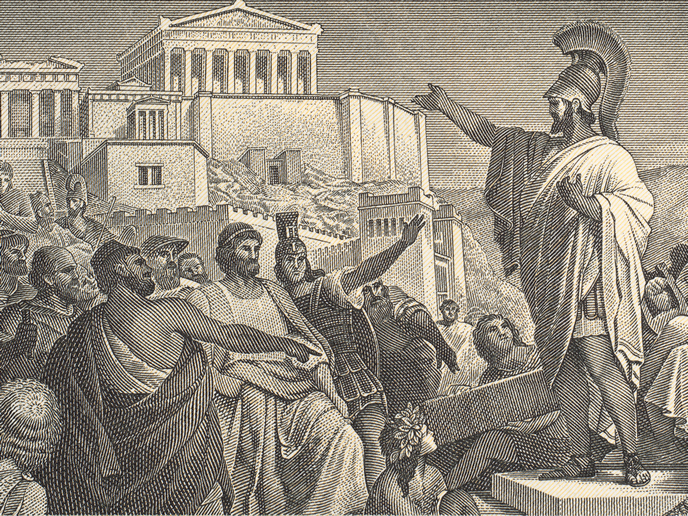
We learned in school that Greece is the cradle of democracy. The word itself means ‘rule by the people’ in Greek. In Athens around 2 500 years ago, everyday citizens, and not just kings or nobles, could vote on laws and help run the government. It wasn’t perfect. After all, women, slaves and foreigners couldn’t vote. Then Rome built on Greece’s ideas. Democracy went dark for a very long time after that. During the Renaissance, Europe started to plant the seeds for modern democratic ideals by rediscovering ancient ideas. Today, our voting systems and parliaments can be traced back to antiquity.
Upending the democracy narrative
A team of American and British researchers appears ready to change long-standing beliefs about the roots of democracy. Published in the journal ‘Science Advances’(opens in new window), their findings on ancient societies from around the world suggest that democracy’s origins extended far beyond Athens and Rome. To investigate how widely democratic systems existed in other cultures, the researchers analysed a broad range of evidence from 40 societies in 31 locations in Europe, the Americas and Asia. They turned to physical evidence, such as settlement patterns, architecture and public spaces, to analyse power structures since many ancient societies left no written records. The results showed that systems resembling democracy existed in several parts of the world. These systems restricted rulers’ authority while enabling ordinary people to participate in governance. The societies mainly included the Iroquois (Native American tribe), the ancient Mesoamerican cities of Teotihuacan and Monte Albán in present-day Mexico, Tlaxcallan, the ancient Native American city that fought the Aztecs, as well as Mohenjo-daro, the Indus Valley city in what is present-day Pakistan.
People power goes global
“People often assume that democratic practices started in Greece and Rome,” commented lead author Gary Feinman, an archaeologist who is also the MacArthur Curator of Mesoamerican and Central American Anthropology at the Field Museum’s Negaunee Integrative Research Center in the United States, in a news item(opens in new window). “But our research shows that many societies around the world developed ways to limit the power of rulers and give ordinary people a voice.” The research team also found evidence of autocracy – a government where one person, such as a king, dictator or emperor, has total power and makes all the decisions alone. “These findings show that both democracy and autocracy were widespread in the ancient world,” stated co-author David Stasavage, a New York University professor. “Significantly, we now have a deeper appreciation of the many factors that affect how governments form and change over time—knowledge that can guide understanding of present-day geopolitical developments.” The study emphasises that democracy requires more than just elections. “Elections aren’t exactly the greatest metric for what counts as a democracy, so with this study, we tried to draw on historical examples of human political organization,” explained Feinman. “We defined two key dimensions of governance. One of them is the degree to which power is concentrated in just one individual or just one institution. The other is the degree of inclusiveness—how much the bulk of the citizens have access to power and can participate in some aspects of governance.”