Developing worm-inspired soft robots

Inspired by nature, soft robotics – devices made of highly flexible materials such as silicon and fluids rather than rigid metals – are opening up a world of applications in fields ranging from medicine to space exploration. “One of the most studied examples in nature is the octopus, which can do incredible things,” says MAPWORMS(opens in new window) project coordinator Arianna Menciassi from the Sant’Anna School of Advanced Studies(opens in new window) in Italy. “It has long tentacles that are also soft, but are able to produce high forces, elongate and grasp.” Menciassi contrasts this with the human arm, which has fixed points of flexibility – the wrist, elbow and shoulder. This means that you can only position your arm in certain ways. The octopus on the other hand has almost unlimited manoeuvrability.
Soft robotic medical devices
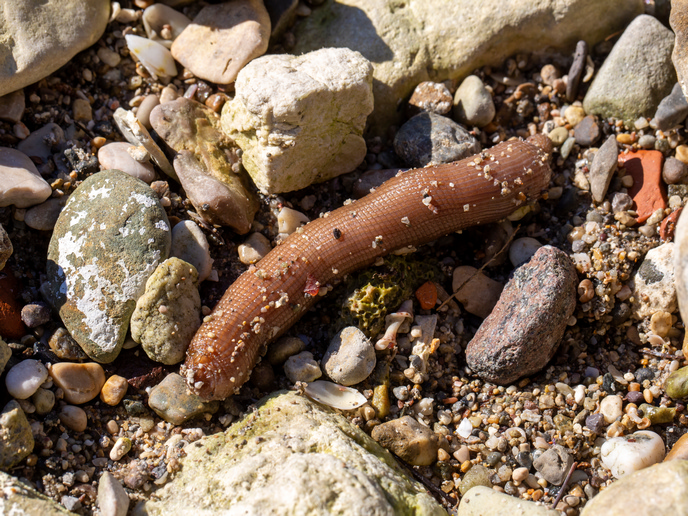
MAPWORMS, which was funded by the European Innovation Council(opens in new window), took another creature as inspiration for its project – the Annelida. This unsegmented aquatic worm burrows into sediments, anchors to holes and crevices, and explores its surroundings by protruding and elongating body parts. It also retracts its body to escape predation. “This worm has a proboscis that can be extended by up to 300 %,” notes Menciassi. “We thought that this ability could be very interesting for a range of potential uses, such as medical devices.” Menciassi worked on a previous EU-funded project called BIOLOCH, which studied the locomotion of caterpillars to advance colonoscopy applications. This helped to inspire the work of MAPWORMS.
Mathematical modelling and novel materials
For this, the project brought together a range of expertise. First, a team of biologists collected Annelida to study them in aquariums. Another team of experts focused on the biological structure of the worms, to characterise what drives locomotion. For this, cutting-edge imaging techniques were used. This led to the development of mathematical models to explain how the worms protrude, retract and crawl. These models were essential for programming the behaviour of the worm-mimicking robot, which was built by Menciassi and her team. For this, novel smart materials based on hydrogels – soft, flexible networks of hydrophilic polymers that can absorb water – were developed. These materials can respond to stimuli such as light, pH and specific chemicals. The end result is a material that mimics the mechanisms of biological systems and enables a tiny device measured at the microscale to replicate the ability of the worm to protrude and crawl.
Exploring possible medical applications
The project was successful in building a prototype device that mimics the ability of the Annelida worm to protrude and crawl. An important development was the application of magnetic activators to bend, torque and reshape the device, mimicking the movement of the worm in nature. These magnetic activators are also ‘soft’, built from silicon and iron particles. “There were also interesting results from a biological viewpoint,” adds Menciassi. “New insights into the worm itself were made.” A database of biological information has been built up, which will lead to a better understanding of the taxonomy, the behaviour and the ecology of Annelida. Potential end uses of this technology will now be explored. One project partner is ACMIT from Austria, a research centre specialising in medical applications. One possible use could be to facilitate brain surgery, enabling microscopic tools to be inserted into the brain. Another application could be to facilitate surgery through the nasal canal.