Innovative ideas to reduce food waste

Every year, around 89 million tonnes of food is wasted in the EU – around 20 % of the total food produced – at a cost of around EUR 143 billion. This represents a significant economic and environmental challenge. “The production and disposal of food waste in the EU leads to the emission of 170 million tonnes of CO2,” explains SISTERS(opens in new window) project coordinator Carolina Peñalva from Aitiip Technology Centre(opens in new window) in Spain. “This also represents a wasteful investment that raises costs for farmers and prices for consumers. Reducing waste is therefore key to easing resource strain and lowering food prices.”
Food production and processing to consumption
The EU-funded SISTERS project sought to identify innovations to cut food loss waste, from production and processing through to logistics and consumption. The primary goal was to reduce waste by 27.4 % and CO2 emissions by about 20 %, in targeted case studies. First, solutions targeting each stage of the value chain were developed. At production, a platform(opens in new window) was created to allow farmers to sell their surplus or rejected production directly to consumers. Smart and reusable food containers (BulkBox and StoreBox) were developed with sensor kits that measure temperature, humidity, CO2 and O2 to keep fresh products in ideal conditions during transport. “We also developed new bio-based and home-compostable packaging solutions, including stretch films, seal films and rigid trays,” says Peñalva. “These materials contain active additives like artichoke leaf extracts to improve food preservation and lessen environmental impact.” Good practice guidelines and a SISTERS Seal of Excellence were developed for retailers, along with a dynamic labelling algorithm that automatically adjusts pricing based on expiration dates and stock levels.
Smart containers and bio-based packaging
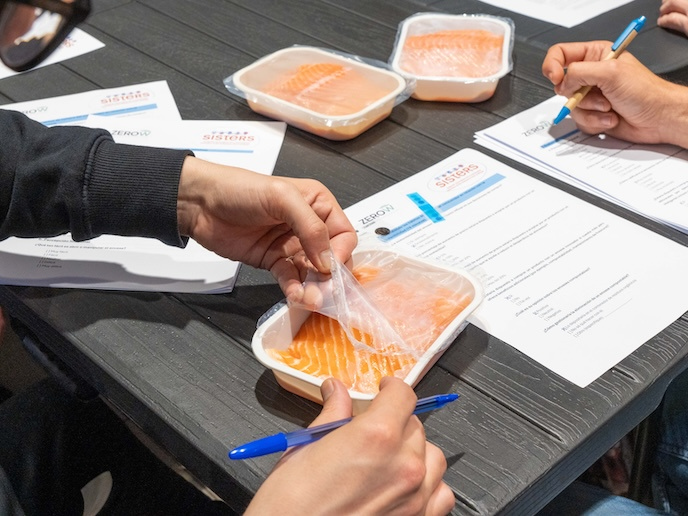
All innovations were thoroughly tested under real-world or industrial conditions. The platform was validated through pilot runs involving around 300 primary producers. The smart containers are trialled with highly perishable goods such as mushrooms, berries, spinach, salmon and cheese, confirming better preservation compared to standard boxes. Bio-based packaging was scaled up to industrial levels and tested on actual processing lines (e.g. fresh-cut apples, sweet peppers and cheese). “The results showed effective food safety and equal or better preservation compared to traditional plastics depending on the food products,” notes Peñalva. Good practice guidelines and the Seal of Excellence were piloted in 35 EROSKI stores across six Spanish provinces, under real operational conditions to assess their scalability and impact on retail food waste.
Business case toolkit and practical guidelines
SISTERS successfully created a strong portfolio(opens in new window) of exploitable results, including the platform, smart containers, and dynamic pricing algorithm and Smart QR labels. The consortium has completed a detailed business plan that includes financial forecasts, and a go-to-market roadmap. “We have finalised the SISTERS business case toolkit and practical guidelines to help companies across the EU food system adopt our technologies,” adds Peñalva. “We have outlined replication pathways and models to ensure long-term sustainability after the project’s end.” Vital consumer insights were also achieved. “Surveys with over 6 500 EU consumers revealed a ‘bioplastic paradox’,” explains Peñalva. “Consumers like bioplastics but often dispose of them incorrectly due to a lack of knowledge. We also found that understanding ‘best before’ versus ‘use by’ dates can greatly reduce household waste.”