Self-organising human organoids open new avenues for disease research


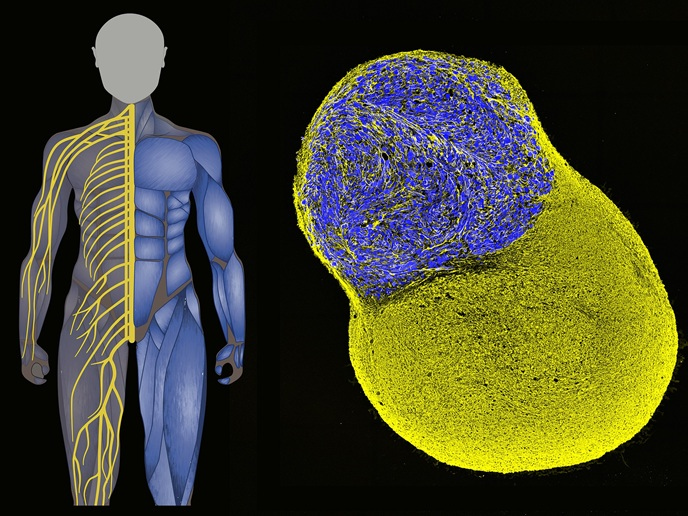
How do your skeletal muscles and nervous system develop in a coordinated way, ultimately forming the functional circuits that allow you to run, jump and dance? Answering this question could unlock new ways to understand and treat devastating neuromuscular diseases such as spinal muscular atrophy (SMA) and amyotrophic lateral sclerosis (ALS). To achieve this, researchers need accurate models of the human neuromuscular system – which is exactly what the GPSorganoids project set out to deliver. “We developed self-organising human neuromuscular organoids that faithfully recreate key functional interactions between spinal motor neurons and skeletal muscle,” says Mina Gouti, group leader(opens in new window) at the Max-Delbrück Center for Molecular Medicine(opens in new window) (MDC), the project host. “The result is a powerful platform for studying neuromuscular development, uncovering disease mechanisms and evaluating potential therapies.”
From modelling disease to discovering new therapies
The project, which received support from the European Research Council(opens in new window) (ERC), delivered several complementary advances that are transforming how scientists study the human neuromuscular system. For example, by introducing controlled electrical stimulation to the neuromuscular organoid platform, researchers could significantly enhance organoid maturation and functionality. According to Gouti, this work demonstrates how integrating developmental biology and bioengineering can generate more physiologically relevant human tissues, providing new opportunities to engineer increasingly sophisticated organoid models. The project also developed a self-organising human neuromuscular junction platform that allows for region-specific disease modelling and scalable drug discovery. Using this platform, researchers developed a model of the junction between a nerve and muscle fibre from patient-specific induced pluripotent stem cells to investigate the mechanisms underlying SMA. “Together, these complementary technologies provide physiologically relevant human models for understanding disease mechanisms, identifying new therapeutic targets and evaluating candidate therapies while creating scalable platforms that accelerate drug discovery,” remarks Gouti.
The importance of curiosity-driven research
From self-organising organoids to region-specific models and scalable neuromuscular junction platforms, GPSorganoids established a new generation of 3D human neuromuscular models that bridge fundamental biology, disease modelling and therapeutic discovery. The work highlights how ERC frontier research strengthens Europe’s competitiveness(opens in new window). “I am confident that our work will help researchers worldwide better understand neuromuscular diseases and accelerate the development of new therapies for treating them,” notes Gouti. The project also put the spotlight on the importance of ambitious, curiosity-driven research. For instance, researchers initially intended to recreate the human neuromuscular system in a dish by harnessing the molecular cues of human development. However, while doing this, they discovered that combining developmental biology with bioengineering could further enhance the physiological relevance of organoids and create entirely new opportunities for therapeutic discovery. “The ERC provided us with the freedom to pursue these unexpected directions in bioengineering, allowing us to not only answer the questions we originally asked, but also build entirely new research directions that will ultimately benefit society,” concludes Gouti. The project was awarded an ERC Proof of Concept grant(opens in new window) to automate the generation and analysis of neuromuscular organoids using robotics and advanced imaging, paving the way for standardised human models and future personalised medicine applications.