Multifaceted proactive management of disinfection by-products in drinking water

Drinking water is routinely treated with chlorine or related chemicals to eliminate harmful microorganisms. Besides disinfection, this can produce chemical contaminants called disinfection by-products (DBPs) associated with health risks. Carrying out effective disinfection without generating DBPs at elevated concentrations is a challenging balancing act for water providers. Global warming and climate change are compounding this threat. Warmer reservoirs, shifting rainfall and extreme weather events alter the organic matter reaching water treatment plants. The EU-funded intoDBP(opens in new window) project set out to enable proactive DBP management across the entire drinking water value chain by integrating monitoring, treatment, modelling and forecasting.
Forecasting organic matter threats and strengthening climate resilience
Predicting how global warming and hydrological change affect organic matter load reaching water treatment plants will help utilities manage DBP formation better. “The project developed short-term (days) and seasonal (months) forecasting tools for dissolved organic matter and extended these to long-term climate scenarios for water sources in Ireland and Spain,” explains project coordinator Wolfgang Gernjak of the Catalan Institute for Water Research(opens in new window). These forecasting tools are complemented by practical catchment protection measures addressing forestry, peatland, agricultural land, reservoirs and wastewater. They can help reduce organic matter inputs before water reaches water treatment plants.
Smarter monitoring and treatment
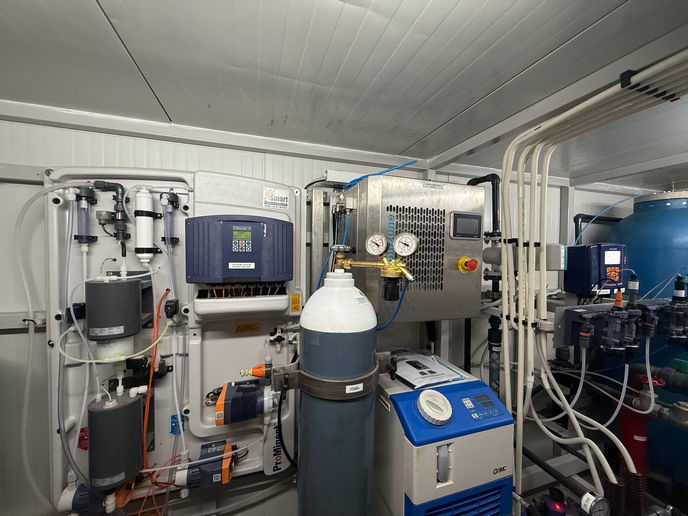
The project improved DBP monitoring by combining real-time optical tools – including ultraviolet-visible spectrophotometry and fluorescence-based monitoring – with advanced chemical and biological analysis. Along with these other tools, high-resolution mass spectrometry provides a more detailed understanding of dissolved organic matter and DBP precursors than conventional monitoring alone. The intoDBP project also adapted the MITO3X® technology for drinking water applications. In Limassol and Barcelona, the technology controlled pre-oxidation (pretreatment that reduces chlorine-related DBP formation) and coagulation for solid removal, with high reagent-use efficiency and low environmental footprint. In Madrid, together with absorbance monitoring to distinguish chloramine species, the technology helped control monochloramine formation associated with minimal DBP formation. A long-term analysis revealed that Barcelona’s modern water treatment infrastructure, with excellent operational control, was able to mitigate climate-related water quality challenges, ultimately providing safer drinking water throughout crisis situations.
Predicting risks in water distribution networks
In the distribution network, DBPs can continue to form when residual disinfectants react with remaining organic matter. “Our DBP-risk-modelling framework combines hydraulic and water-quality models with field measurements to predict DBP behaviour across distribution networks,” notes Gernjak. An early warning system identifies areas approaching safe thresholds and provides management options, enabling action before thresholds are exceeded.
Data gaps and human behaviour
Climate-resilient drinking water management will require better long-term data. Ireland and Cyprus provided valuable descriptive evidence but lacked Barcelona’s harmonised records on water quality, source contribution, treatment and operations, making long-term statistical analyses impossible. Furthermore, although regulated DBPs are an important drinking water quality indicator, they are not the main hazard – intoDBP revealed important data gaps regarding non-regulated DBPs including nitrogen-containing ones in drinking waters across Europe. The project also underscored the role of water quality in supporting sustainable individual choices. In harmonised surveys with almost 2 000 participants in the case study areas of Barcelona, Cyprus and Ireland, the participants’ perception of tap water quality was a key factor in choosing tap, bottled or filtered water. “The project showed that DBP risk can be anticipated,” says Gernjak. “Its forecasting, monitoring and treatment tools transform utilities’ management from reactive to proactive, achieving microbiological and chemical safety in the face of climate-related challenges.” Partnership in the ZeroPollution4Water Cluster(opens in new window) contributes to a European effort on resilient water management.