Transforming wind turbine waste into valuable industrial resources



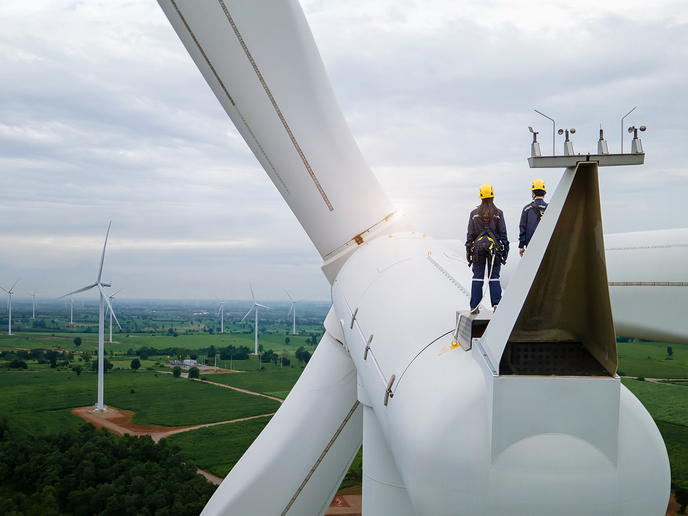
What until recently ranked as one of the energy transition’s most challenging waste problems could now become a source of valuable raw materials. End-of-life wind turbine blades are large, complex and notoriously difficult to recycle, leaving much of the sector reliant on landfill disposal and incineration. To tackle this, the EU-funded REWIND(opens in new window) project set out to build a complete value chain for wind turbine blade circularity, proving that retired blades can serve as industrial resources rather than waste. Coordinated by plastics technology centre AIMPLAS, Spain, and bringing together 13 European partners, the project is developing practical, scalable solutions across the full lifespan of a blade.
Recognition from the composites industry
REWIND’s progress since its launch in 2024 has now been highlighted in the September - October issue(opens in new window) of JEC Composites Magazine’s ‘Technology: Recycling’ section. The feature acknowledges the consortium’s work in creating sustainable pathways for the reuse and recycling of composite materials, demonstrating how end-of-life wind turbine blades can be transformed into valuable resources for new industrial applications. It also highlights the partners’ advances in blade dismantling, materials characterisation, cutting optimisation and innovative recycling technologies that are opening high-value recovery routes for composites. Appearing in one of the sector’s leading international publications underscores the significance of REWIND’s contribution to a circular wind energy economy.
Milestones met as the rules change
During the first two years, the project cleared its first two technical milestones. The first involved securing a supply of undamaged, dismantled blade sections. This provided more than 20 m2 of material – roughly the surface area of two family cars – now being given new purpose in applications ranging from electric commercial vehicle panels to thermal insulation. The second milestone involved the validation of a model that predicts the residual mechanical properties of end-of-life blade components with more than 90 % accuracy. This is a critical step towards reusing recovered materials with confidence. The results arrive at a pivotal moment. On 1 January 2026, a voluntary ban on sending decommissioned blades to landfill, promoted by WindEurope(opens in new window), took effect across the sector. By extending the life of composite materials and turning waste into resources, REWIND is helping cut landfill disposal and incineration as the industry moves towards disposal-free operations. Next on the agenda for REWIND is to scale up its technologies, validate industrial demonstrators and speed up the market uptake of circular solutions for wind turbine composites. The breadth of the project partners’ expertise reflects the ambition: dismantling and non-destructive material identification, cutting optimisation and long fibre delamination, electropulse fragmentation, and advanced pyrolysis and solvolysis routes, as well as the conversion of recovered fibres into fabrics, structural panels and insulation. By bringing this diverse expertise together, REWIND (Efficient decommissioning, repurposing and recycling to increase the circularity of end-of-life wind energy systems.) demonstrates that Europe’s wind sector is edging closer to a genuinely circular future. For more information, please see: REWIND project website(opens in new window)