Translations in the blink of an eye

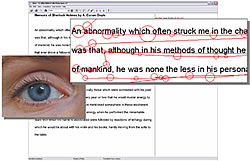
It is considered important to develop new tools that can aid natural forms of interaction in multiple languages. The I-EYE project concentrated on just that. The project focus was eye-based interaction, where gaze is essentially used as an input channel. Within this framework, researchers developed iDict, a gaze-assisted environment used for reading foreign language documents in electronic format. iDict provides automatic, instant translations for any part of the document, where the reader appears hesitant. The system is designed to detect the changes in eye gaze behaviour and at that point provide the translation either audibly or on screen. The system offers the obvious advantage of providing the translation to any word within the document, without any further input other than the change in the reader's gaze. Scientists observed that gaze behaviour is altered within the reading process when comprehension problems are encountered. This formed the starting point for the development of iDict. Furthermore, translations are offered in the correct grammatical form and can also be requested manually with a mouse click. Currently available languages include Finnish, Italian, German and English. iDict forms part of a new generation of products which could revolutionise learning methods and interactions within a multicultural society. Its applications vary, although iDict is likely to be of particular importance to academic institutions and learning organizations.