Monitoring the ocean from far above

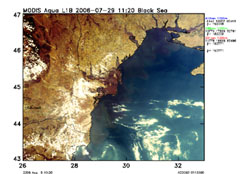
It is nearly impossible to perform enough in-situ measurements in the Earth's vast oceans to gain a representative picture, hence remote sensing plays an important role in oceanography and coastal management. Argoss' scientists analysed the radiance backscattered from the ocean's surface in order to derive a number of different parameters. Specifically, an inversion method was applied to obtain near-surface concentrations of suspended sediment and chlorophyll. Argoss tested its new technique on SIOP (Specific Inherent Optical Properties) data from the North and Baltic Seas provided by Rijkswaterstaat AGI. The results compared well against current methods in use and boast several advantages. For instance, the same model can be applied to infer several different parameters and is region-independent. Furthermore, the method is also compatible with non-linear bio-optical models. Argoss incorporated its technique into the widely used SeaDAS software package created and distributed by NASA. It is thus appropriate for use with data from the SeaWiFS and MODIS sensors. Based on this result, Argoss offers consulting services to both governmental and private organisations (e.g. dredging companies) active in the coastal management sector.