Cleaning up our seas, top to bottom


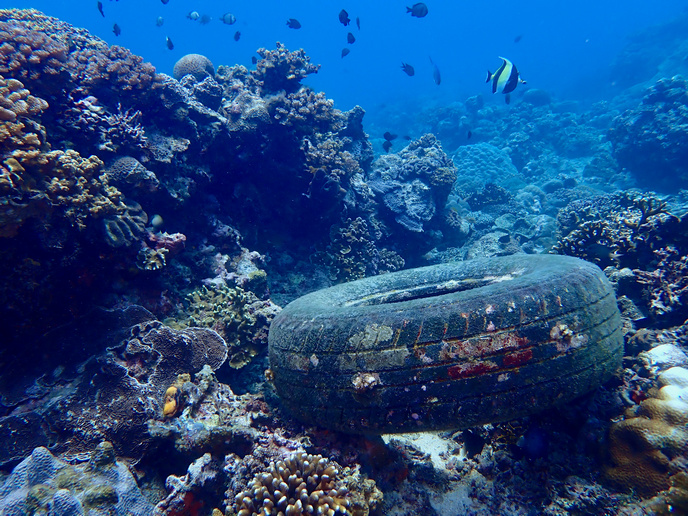
The EU-funded SeaClear2.0(opens in new window) project is deploying teams of autonomous, intelligent robots to monitor and collect litter from the sea’s surface and, more importantly, its floor. Its integrated approach addresses the full cycle of marine litter, contributing to the EU’s mission to restore and protect our ocean, seas and inland waters by 2030. Every year, up to 600 000 tonnes of plastic waste ends up in Europe’s seas, and the vast majority of it settles on the seabed. While all seas across Europe are affected by plastic pollution, the Mediterranean bears the greatest burden. This is primarily due to a combination of high human pressure – caused by densely populated coastlines, intense tourism and inefficient waste management – and the Mediterranean’s semi-enclosed basin, with very limited water exchange with the Atlantic Ocean. “There’s a huge amount of litter that ends up in the sea,” notes Bart De Schutter, a professor at SeaClear2.0 project coordinator Delft University of Technology, the Netherlands, in a recent news item(opens in new window) posted on ‘Euronews’. “Many projects target surface litter, but we look at the sea floor,” adds De Schutter. “It’s important to remove rubbish there, because it can contaminate the environment.”
Using hawks, dragons, turtles, bees and cats
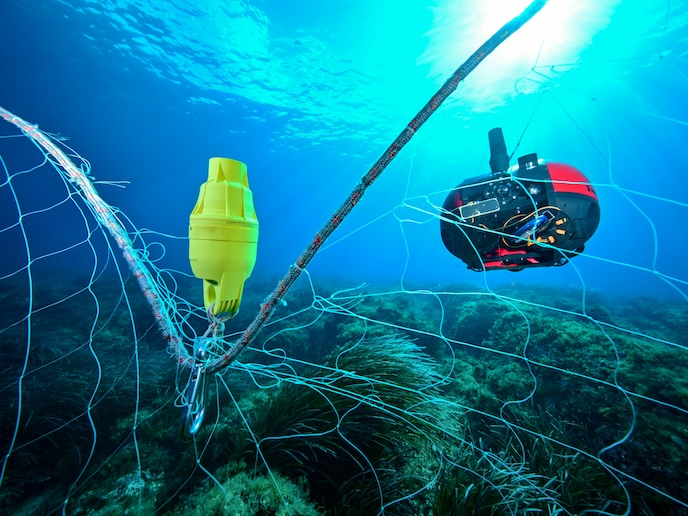
SeaClear2.0 builds on the achievements of its predecessor, SeaClear, which developed the first autonomous robotic system for seafloor litter collection. The current system consists of a fleet of smart robots, with an autonomous, remote-controlled uncrewed surface vehicle (USV) called the SeaCAT serving as its central hub. The SeaCAT coordinates and deploys multiple robotic assets to detect, classify and collect marine litter. Tethered to the SeaCAT is an aerial drone called the SeaHawk that identifies litter hotspots. The Mini TORTUGA (Spanish for ‘turtle’), a compact and highly manoeuvrable underwater rover deployed by the SeaCAT, is used to map the seabed and identify debris before collection operations. A custom-built robotic gripper is used to securely grasp objects of different shapes and weights in challenging underwater conditions. SeaBees, compact mini-drones adept at navigating tight spaces, are deployed to collect litter with nets. Finally, the project’s second USV, the SeaDragon, is used to deposit the waste collected and transport it back to shore. The SeaClear2.0 system has already been tested in a marina in Marseille, France, and in Germany. “In tests, we’ve already removed rubber tyres, metal fences and parts of ships,” comments De Schutter. “Using a crane on the surface vessel, we can lift even heavier objects.” The SeaClear2.0 team plans to further streamline the technology by the project’s end in December 2026. “We’re not exactly where we want to be yet,” states Yves Chardard, CEO of French project partner Subsea Tech. “But we’re not far off.” Further testing is scheduled to take place in Venice (Italy), Dubrovnik (Croatia) and Tarragona (Spain). In February 2026, SeaClear2.0 (Scalable Full-cycle Marine Litter Remediation in the Mediterranean: Robotic and Participatory Solutions) held a week-long winter school dedicated to advancing marine robotics for a cleaner ocean. Hosted by German project partner Technical University of Munich, the event brought together 42 researchers from 16 countries to explore cutting-edge autonomous underwater systems designed to identify and collect litter from the seabed. For more information, please see: SeaClear2.0 project website(opens in new window)