Novel moored ocean buoy

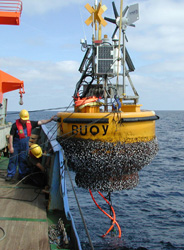
Due to the difficulty in deploying and maintaining sensors in the open ocean, long-term time series of different physical and chemical parameters are lacking. In particular our knowledge of the evolution of sub-surface parameters in time and space is very poor. In order to address this issue, the Center for Marine Environmental Research (MARUM) in Germany led the development of a new moored ocean buoy in the ANIMATE project. Moored systems are suitable for operation in remote locations and offer a good deal of flexibility. The main innovative aspect of the new buoy is the fact that data from submerged sensors can be relayed to scientists back onshore in real-time. This not only allows immediate access to and analysis of the data, but also early warning of any equipment malfunction. The key was constructing electrically conductive swivels to allow inductive data transfer via the cable that holds the buoy in place. In this way, measurements from sensors down to 1500 meters below the surface could be relayed to the surface transmitter. Satellite telecommunications solutions were implemented with both the ARGOS and ORBCOMM systems. MARUM and its partners are looking to promote the ANIMATE prototype to organisations active in deep sea monitoring. They are also working to improve the durability of the surface vessel that hosts the satellite transmitter to avoid losses to fishing and other threats.