Lesions disclose viruses identity

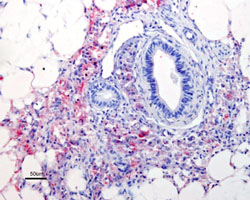
Animal viral diseases have been one of the major concerns of the key players in the integrated EU market for food products. Their wish is to increase their competencies and secure a share in an increasingly globalized world addressing food safety and risk issues effectively. In this frame, efforts have been directed towards developing new tools to identify viral pathogens and take preventive actions against their spreading. Salmonid alphavirus (SAV), a term coined to describe two different causal agents that evolved from the alphavirus genus, is a serious threat to farmed fish. These agents are known to be responsible for trout sleeping (SD) and salmon pancreas (SPD) diseases. Hence, researchers make coordinated efforts to enhance their understanding of SAV's pathogenicity by improving molecular characterisation of SAV and elucidating its mechanism of action. To this end, SPD/SD DIAGNOSIS partners performed histopathological examination to identify characteristic lesions in fish pancreas and associate their severity to the stage of the disease. The technique of immunohistochemistry (IHC) is widely used for protein localization on cell surfaces through specific antibodies. Despite its medium sensitivity, IHC is considered a powerful tool because of its diagnostic power to detect the etiology agent in diseased fish. In an effort to establish the full diagnostic potential of IHC, tissue samples from diseased fish pancreas were employed. The network partners showed that use of a specific antibody for pancreas disease could identify the occurrence of lesions in diseased fish. In addition, differential diagnosis was possible distinguishing the pancreatic disease (PD) virus from the infectious pancreatic necrosis virus (IPNV). The latter is known to overgrow SPDV in cell culture and to induce similar to PD lesions. Researchers envisage advancing the knowledge derived from their experiments through a collaboration scheme with other scientists with expertise in applying immunohistochemistry for PD.