Revealing the secrets of artic ice

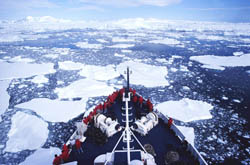
Weather forecasting is serious business for some. Sea based activities rely on accuracy to determine the level of threat they will encounter during their off-shore activities. Tourists rely on accurate weather forecasts to plan their vacationing destinations. Therefore, greater accuracy in weather prediction is akin to better risk-management and disaster control procedures. The artic ice capped regions provide a highly useful but greatly underutilised source of information that could be used to improve our understanding of weather conditions. The IOMASA project undertook the development of remote sensors and satellite technologies to further improve the data. In brief, the IOMASA project had three primary objectives. These include the remote sensing of temperature, humidity, cloud cover and water cover over sea and land ice, the improvement of remote sensing and the improvement of numeric atmospheric models by assimilation. The advantage of this is that it now allows one to work with models based on more frequently observed polar regions. A large part of the inaccuracy of numerical weather forecast stems from the fact that there is a lack of observation of the atmospheric state in these regions. The project has delivered some impressive results, including an algorithm that retrieves the total water vapor content of the atmosphere. Also, a new method for estimating microwave sounding channel emissivity over sea ice, and a quality control method for asymmetric (cloud water) contamination. It is therefore expected that the application of the project results will improve weather forecasts for Northern Europe and artic regions. This also includes improved precipitation forecasts, cloud cover. It is also expected that the results will be used to improve future sensors to be included in European satellite technology.