Increasing reliability in the microelectronics design

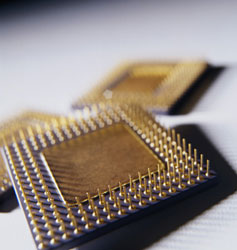
The ever increasing market needs for ongoing miniaturisation in modern electronics have brought new demands on further optimisation in the design of integrated circuitry. A critical parameter in the design of a nano- or even a micro-electronic device is the product and process reliability. Taking into account that cost and time-to-market also need to be reduced, failures in the design of micro-electronic packaging and assemblies have to be minimised. Motivated by this, the MEVIPRO project focused on one of the most common types of electronic failure, the thermo-mechanical one that originates from the product/process design phase. The main outcome of project work was a versatile virtual prototyping method that can improve thermo-mechanical designs of various products. This achievement involved, among other tasks, the development of suitable simulation and characterisation methods for assessing the thermo-mechanical reliability of microelectronics and microsystems. Conventionally used methods for assessing the reliability of new microelectronics include destructive and non-destructive testing of physical prototypes. This is a very time consuming and costly procedure as it needs to be repeated until the design criteria are met. Alternatively, numerical and experimental tools have been developed that can significantly reduce the time required to design a part or a product. The tools include suitable models for testing the thermo-mechanical behaviour of polymers and failure criteria. In addition to these simulation techniques, methods for assessing the fatigue behaviour of thin wires as well as solders and adhesives were also developed. Particularly for solder materials' checks, a thermal lap shear test was also generated. Numerical models, characterisation and wire fatigue experiments were successfully tested and found easy to employ in the design of reliable electronics and microsystems. For further information click at: www.quick.philips.com/mevipro