Understanding the origin and evolution of the Milky Way

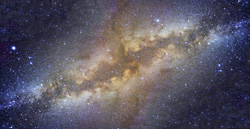
The Milky Way Galaxy of which we are a part is a spiral galaxy resembling a child’s pinwheel. It consists of three parts that can be best imagined when turned horizontally, where it looks like a stereotypical flying saucer surrounded by a halo of less dense stars. The flying saucer part is the Galactic centre and nuclear bulge together with the Galactic disk that contains the majority of stars including the Sun. The halo is a roughly spherical distribution containing the oldest stars in the Galaxy. Demonstrating how the combined analysis of data obtained at very different wavelengths and with very different instrument modalities could reveal important insights not available from analysis of individual data sets alone was the impetus behind the EU-funded ‘TeV gamma-rays and radio signals: Making the connection’ (TEVGRRS:MTC) project. Scientists employed a combined analysis of data obtained from the latest astro-particle detectors (gamma-ray and neutrino detectors) and radiointerferometers to make predictions about the magnetic field structure and amplitude of the Galactic Centre of our Galaxy in order to guide important future experiments. Analyses demonstrated that the magnetic field in the Galactic centre is extremely strong, at least 10 times stronger than that in the Galactic disk. Furthermore, scientists showed that a powerful wind blows out of the Galactic centre as a result of star formation there on time scales approaching the age of the Galaxy itself. Most importantly, the TEVGRRS:MTC investigators proposed that this star-formation activity has produced the ‘Fermi Bubbles’ recently observed by the Fermi gamma-ray telescope. The Fermi Bubbles are two huge gamma-ray–emitting bubbles extending north and south of the Galactic centre. The link between an observable phenomenon (the Fermi Bubbles) and its origin in Galactic centre activity over the life of the Milky Way suggests that Fermi Bubbles can act as de facto measures of the origin and evolution of our Galaxy. Results were published in several highly esteemed journals, including Nature, and not only demonstrated the technical importance of combined-wavelength analyses but also provided an important research direction for the state-of-the-art ANTARES neutrino detector given that Fermi Bubbles are a promising source of neutrinos.