


Trending Science: What if space dust had brought alien life to Earth?
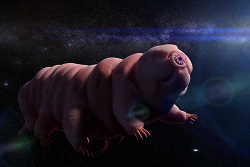
This will probably sound familiar to all those watching Netflix’s reboot of Star Trek Discovery: the universe might not be as void of life as one might think. Tardigrades – micro-building blocks of plants and animals that can be found on Earth and are also known as ‘water bears’ – are famous for their capacity to survive in space. They are virtually indestructible on Earth and, as the European Space Agency found out in 2008, they can survive the low pressure and intense radiation found in space. At the time, the ESA could only find this out by sending Earth’s own tardigrades into space for 10 days. A study published this week by the University of Edinburgh has pushed the investigation a bit further, by considering the possibility of tardigrades or other microorganisms being moved from planet to planet by the ‘fast-moving flows of interplanetary dust that continually bombard our planet’s atmosphere’. These particles, 60 tons of which get to Earth every day, can travel as fast as 70 km per second, in a stream strong enough to collide with living organisms in the outer layers of the planet’s atmosphere before bouncing back into space. Once there, such organisms could easily end up on the likes of comets to continue their journey, provided that they make it this far. ‘The most likely scenario for thrusting them into space would require a double-stage approach, whereby they are first hurled into the lower thermosphere region or higher by some mechanism and then given an even stronger kick by fast space dust collision, which eventually leads to escape velocity and an exit from the Earth's gravity,’ explains Dr. Arjun Berera, Professor of the School of Physics and Astronomy at the University of Edinburgh. According to Dr Berera, such mechanisms could spread the strongest living organisms, such as microbes, bacterial spores, lichens, thermophile and (…) tardigrades, across the solar system. They could also cause these organisms to land on another planet, and even, ‘provide a universal mechanism both for the exchange of the atomic and molecular constituents between distant planetary atmospheres and for initiating the first step of the panspermia process.’ Dr Berera’s study was published in the journal Astrobiology.
Countries
United Kingdom