Virtual learning for the blind

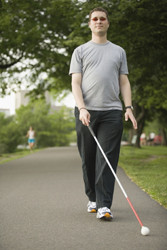
Scientists under the aegis of the EU-funded project 'Learning and rehabilitation using haptic, audio and visual feedback in virtual reality environments' (LR HAV VRE) are researching and developing several such technologies for the blind. A combination of haptic (i.e. sense of touch) and auditory feedback was used to provide information and improve the learning process. Project members carried out four studies to improve orientation skills and to develop a learning and rehabilitation tool. In the first study, four blind participants used the BlindAid system to navigate unknown complex real spaces (RSs). Participants showed good orientation and cognitive mapping skills. For the second study, researchers transformed the BlindAid system into a learning and rehabilitation tool. This 3D audio system was used as a simulator to create a virtual map using a hand-held stylus. Totally and partially blind people were included in this study to assess their ability to gather spatial information and use it to navigate RSs. Results were highly promising, leading to publications in several international scientific journals and presentations at international conferences and scientific meetings. The third study is part of collaborative research between research groups from Nottingham Trent University and Tel Aviv University, and continues and extends the research of Evett (Evett et al, 2008; 2009). This study involved developing a virtual cane for performance comparison with the BlindAid system. The virtual cane is part of a readily available Nintendo Wii technology that was adapted to scan the environment, detect motion and provide auditory feedback. Simple and complex RSs were explored by the blind participants to evaluate exploration and cognitive mapping processes and their efficacy with regard to navigation. Currently, data collection and analysis are ongoing. In the fourth study, a VLE was used to provide science education through auditory feedback of important parameters. Researchers modified an existing system to develop a computer model to simulate complex scientific models. Study outcomes were disseminated via international scientific journal publications and at two international conferences. Successful development of such VLE systems for the blind could find several applications that include navigating unknown territory and an effective rehabilitative programme. Such hand-held tactile systems could help blind people become more independent and confident while handling routine daily activities and learning new skills.