


Potocnik reveals further plans to support research and innovation
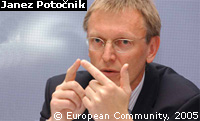
The EU Science and Research Commissioner, Janez Potocnik, has provided details of further EU initiatives planned under the Commission's recently adopted integrated Action Plan on research and innovation. The Action Plan was published on 12 October, and detailed 19 individual actions structured around four main themes: 'research and innovation (R&I) at the heart of EU policies', 'R&I at the heart of EU funding', 'R&I at the heart of business', and 'improved R&I policies'. Some of the actions build on previous EU activities, but many are new initiatives. Speaking at the European Investment Bank annual forum in Helsinki, Finland, on 28 October, Mr Potocnik said: 'We need to invest more [in R&I] and we need to invest better. [A]bove all, we need to create real tangible links between research and innovation so as to enable technology transfer into the industry as well as between research and other economic policies.' In order to put R&I at the heart of EU policies, in the new Action Plan the Commission signalled its intention to publish guidelines on the efficient use of research and development (R&D) tax incentives, and Mr Potocnik further elaborated on the plans during his speech. More and more countries are developing tax incentives for R&D, he said, including France, the Netherlands, the UK, Spain, Hungary and others. 'The problem is that these schemes have been designed with a purely national perspective. As a result, some schemes are discriminatory towards research contracted in other European countries. These schemes have to be changed.' The Commissioner continued: 'Countries that would exclude from their tax schemes the research outsourced to organisations from other Member States, would de facto deprive their economy of the benefits of the integrated European Research Area - their businesses would be discouraged from looking for the best research across Europe. 'No national economy can afford such a loss. [...] So we will adopt next year a communication giving guidance to Member States on the most effective ways to design tax incentives for research and innovation.' Mr Potocnik said that there is much to be done to achieve another objective of the Action Plan, that of placing R&I at the heart of business. One of Europe's clear weaknesses in this area is the lack of cooperation between universities and businesses, particularly across national borders. 'Some of the main issues relate to contractual negotiations, notably how to deal with intellectual property,' said the Commissioner. 'We have been working with some of the main stakeholders to identify best practices. Based on this, we will in 2006 propose guidelines for cooperation and knowledge transfer between public research and industry.' The guidelines will provide a solid basis for contractual negotiations and considerably facilitate trans-national cooperation, he added, creating a 'level playing field for universities and businesses'. 'We are still at the stage of proposals,' Mr Potocnik concluded. 'There is intense work ahead of us. You can rest assured that I will work my hardest [...] in order to make these proposals a reality.'