


LERU Kids University aims to inspire a new generation of young scientists
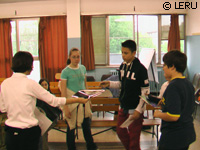
Between 7 and 11 November, ten research-intensive universities from eight European countries each hosted a 'Kids University' for children aged ten to 12, as part of an EU-funded initiative to promote science and research to young people and their parents. The initiative was organised by the League of European Research Universities (LERU), an association of 12 institutions that aims to promote the importance of basic research within European higher education. On 23 November, representatives of the ten LERU universities participating in the Kids University met in Brussels to assess the success of the initiative during a final event. In his introductory speech, LERU President and Chancellor of the University of Helsinki, Kari Raivio, made the point that excellent young musicians and sportspeople are encouraged to develop their talents from a very young age. 'But how can we do the same for children with other talents, such as mathematics, particularly when school curricula must be all inclusive?' he asked. The idea behind the Kids University, said Professor Raivio, was to promote scientific talents and give children something to stimulate them. Children took part in experiments and lectures on physics in its broadest sense, as part of the 2005 'Year of Physics'. 'The Kids University is an excellent initiative,' said the Professor 'as it exposes them to science and research at an early age, and might give them the spark needed to follow their interest in science,' The one-year initiative was funded as a specific support action under the 'science and society' priority of the Sixth Framework Programme (FP6). Etienne Magnien, a Head of Unit at the science and society directorate of the Commission's Research DG, told the LERU partners: 'Just six months after signing the contract for the Kids University we get to see the first results, which is very satisfying.' Mr Magnien said that while similar initiatives have previously been organised on a local or national level, the LERU project sets itself apart by bringing together the experience of 12 research-focussed institutions, and is able to combine the curiosity of children with the curiosity of working researchers. The coordinator of the Kids University project, LERU Executive Director Katrien Maes, picked up on Mr Magnien's themes when she spoke to CORDIS News. 'A number of the LERU universities have organised similar outreach activities before,' she said 'but making a coordinated event at European level is a way for our institutions to come together and learn from each other. It will hopefully lead to more activities, and some universities have already said that they will organise the event again next year, with or without EU support.' Dr Maes believes that the target age group for the Kids University is an important factor in the success of the project: 'The ten to 12 age group is a crucial time to get kids interested in science. With teenagers, unfortunately, it is often too late, as they may already have had bad experiences with science.' Dr Maes stressed that teachers were not to blame, but echoed the LERU President's comments in asserting that the education system can leave some children bored or unfulfilled. Some of the LERU universities attracted the participation of over 500 children in their events, but CORDIS News asked Dr Maes what effect the initiative would have on young people's engagement with science throughout Europe. 'You have to take a multiplicity of approaches to reach out to kids, and this is just one part in a much larger whole,' she replied. Dr Maes stressed that the events had also brought teachers and parents into the universities, and they will therefore have gained from the experience too. This last point was taken up by the Secretary General of LERU, David Livesey, who concluded: 'The Kids University is also a good way of engaging with parents, making adults aware of the role and contribution of universities and science to society. This helps us to build the case for adequate funding of universities and research.'